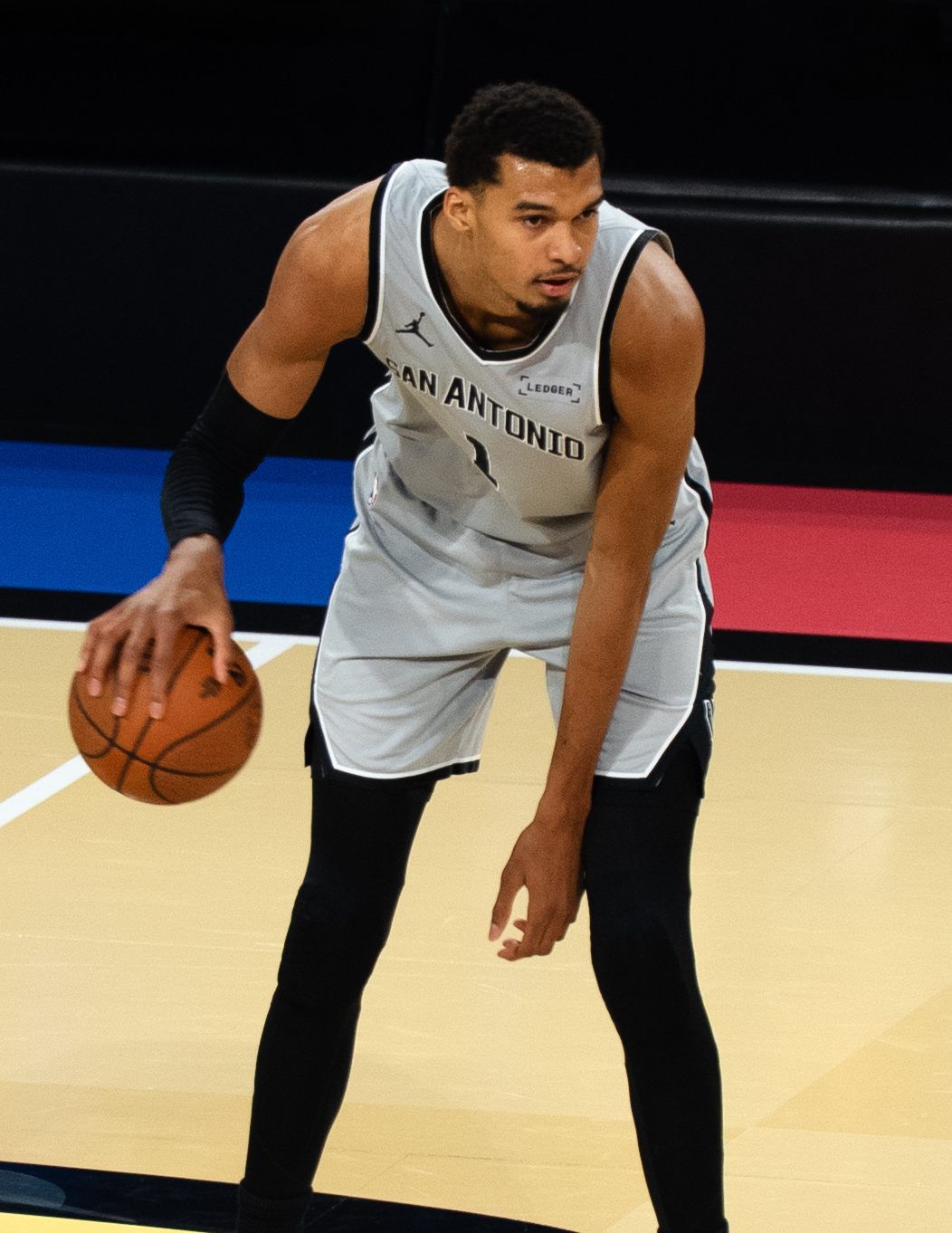
The San Antonio Spurs' 111-103 road win over the Oklahoma City Thunder in Game 7 of the 2026 Western Conference Finals was not a simple superstar scoring story.
Victor Wembanyama finished with 22 points and seven rebounds. Shai Gilgeous-Alexander scored 35. If the box score is the only evidence, Oklahoma City's lead creator appears to have had the louder individual night.
But that misses the real lesson of the game.
Wembanyama did not need a 40-point line to control the environment. His value came through defensive reach, rim deterrence, off-ball gravity and the way Oklahoma City had to think before every drive, cut and interior pass. A 22-point night can still be a dominant night when one player changes what the other team believes is available.
AP reported that San Antonio beat Oklahoma City 111-103 on May 30, 2026, sending the Spurs back to the NBA Finals for the first time since 2014. Wembanyama later received the Earvin "Magic" Johnson Trophy as Western Conference Finals MVP.
So the better question is not whether 22 points is a huge scoring line. It is why the Thunder looked so constrained by a player whose impact was bigger than his visible numbers.
The Verified Frame
| Item | Detail |
|---|---|
| Game | 2026 Western Conference Finals, Game 7 |
| Result | Spurs 111, Thunder 103 |
| Location | Oklahoma City |
| Wembanyama's Game 7 line | 22 points, seven rebounds |
| Gilgeous-Alexander's Game 7 line | 35 points |
| Series award | Wembanyama named Western Conference Finals MVP |
| Bigger result | San Antonio advanced to the NBA Finals |
NBA.com framed the matchup before Game 7 as a rare duel between the league MVP and the Defensive Player of the Year: Gilgeous-Alexander on one side, Wembanyama on the other.
That context matters. This was not just a young team surviving a road game. It was a pressure test between two different forms of modern basketball power.
Why One Block Can Still Mean Defensive Control
Blocks are easy to count. Defensive gravity is not.
Wembanyama's most important defensive possessions often happened before a shot:
- a ball handler stopped early instead of attacking the rim;
- a cutter hesitated when the weak-side lane looked open;
- a floater became more rushed;
- a drive turned into an extra pass;
- a paint touch became a lower-value perimeter reset.
Those plays do not always become blocks, steals or rebounds. But they shape the offense.
Oklahoma City had depth, shooting, speed and Gilgeous-Alexander's elite half-court creation. Even then, Wembanyama's presence compressed the most valuable space on the floor. The Thunder did not simply have to beat a defender. They had to account for a defender who could recover across angles that usually stay open.
That is why his one-block line can understate his real defensive effect.
His Offensive Gravity Was Not Only About Scoring
The source commentary's strongest basketball idea is that Wembanyama's offensive influence can be larger than his scoring total.
That sounds exaggerated until the possessions are broken down.
When Wembanyama has the ball, defenses must respect three threats at once:
- He can shoot over most matchups from the perimeter.
- He can take one long step into the paint and force a collapse.
- He can operate from the elbow or high post as a scorer, passer or quick-decision hub.
The harder problem is what happens when he does not have the ball.
If Wembanyama cuts from the high post, drifts toward the dunker spot or flashes into the lane, the defense naturally contracts. Even without a touch, he can pull Oklahoma City's back line inward and create cleaner passing windows to the corners and wings.
Stephen Curry's gravity stretches defenses away from the basket. Wembanyama's gravity can pull them toward it. Both create space. They simply bend the floor in different directions.
Wembanyama vs. Gilgeous-Alexander: Different Kinds of Pressure
Gilgeous-Alexander's 35 points were real. He remained Oklahoma City's best offensive answer, and scoring that much in a Game 7 against an elite defensive presence is impressive.
The problem for the Thunder was that his pressure and Wembanyama's pressure worked differently.
| Category | Shai Gilgeous-Alexander | Victor Wembanyama |
|---|---|---|
| Main value | On-ball scoring, foul pressure, midrange creation | Rim protection, defensive coverage, vertical gravity |
| Strongest area | Ball-side creation and paint-adjacent scoring | Paint control, weak-side influence, high-post and roll pressure |
| Off-ball impact | More dependent on re-entry and set actions | Still shifts the defense through cutting and positioning |
| Box-score visibility | Points, free throws and assists are easy to see | Changed shots and forced hesitation are harder to measure |
| Game 7 meaning | Oklahoma City's offensive engine | San Antonio's two-way structural anchor |
This is not an argument that Gilgeous-Alexander played poorly. He did not.
It is an argument that Game 7 impact cannot be reduced to who scored more points. The player who makes the entire floor easier for his teammates can outweigh the player who wins the scoring column.
San Antonio's Real Breakthrough Was Internal Growth
The Spurs' rise was not only the result of one transaction or one hot shooting night.
It came from internal growth.
Wembanyama became more comfortable as a playoff focal point. San Antonio's younger players understood where to be around him. The team learned how to use his rim pressure as both a defensive foundation and an offensive spacing tool.
That kind of improvement can look gradual during the regular season, then suddenly become obvious inside a seven-game series. Early in the matchup, Oklahoma City's depth and pace could make San Antonio look young. As the series stretched, the Spurs seemed to learn faster than the Thunder could suppress them.
That is the danger of a young core built around a player like Wembanyama: the team is not fixed. It can improve while the series is still happening.
The "Justice Basketball" Narrative Needs a Cooler Translation
The Chinese video frames San Antonio's win as a kind of "justice" victory. That is a strong fan-language phrase, but it needs careful handling in an article.
The Spurs did not win because they were morally superior. A cleaner interpretation is that many viewers saw San Antonio as representing a more satisfying basketball style:
- more team structure;
- more defensive accountability;
- more reliance on execution than whistle hunting;
- a young star whose dominance looks rooted in skill, length and timing.
That does not prove anything about officiating. It describes a fan reaction.
The stronger basketball explanation is enough: San Antonio protected the rim, survived Gilgeous-Alexander's scoring, used Wembanyama to bend the floor and executed better in the highest-pressure game of the series.
Why This Game Matters
Wembanyama is no longer only a future-tense projection.
He has now shown that his model can survive playoff targeting. Opponents can prepare for him, adjust to him, test his handle, crowd his catches and try to move him in space. If he still controls the most important zones of the game, the conversation changes.
His uniqueness is not height alone. It is height plus mobility, timing, shooting touch, passing vision, rim protection and learning speed. Most big men can be pulled away from the basket. Most perimeter stars cannot protect the rim. Wembanyama connects those two ends of the floor in a way that gives San Antonio unusual margin for error.
That is why this Game 7 may age as a marker. It was the night Wembanyama's postseason value became less theoretical and more structural.
Conclusion
Spurs-Thunder Game 7 should not be remembered only as "Wembanyama's 22 beat Shai's 35."
The better version is this: Gilgeous-Alexander won the scoring column, but Wembanyama changed the game environment.
He made Oklahoma City hesitate at the rim. He pulled defenders inward without always touching the ball. He gave San Antonio a defensive floor and an offensive organizing principle. That is why a 22-point Game 7 can still explain a Western Conference Finals MVP.
FAQ
Why did Victor Wembanyama win Western Conference Finals MVP?
He was the structural center of San Antonio's series win. His scoring, rebounding, defense, shot deterrence and floor-bending presence shaped the matchup beyond Game 7 alone.
Was Wembanyama dominant if he scored only 22 points in Game 7?
Yes, but not in the traditional scoring-only sense. His dominance came through defensive gravity, rim deterrence, off-ball movement and the way he changed Oklahoma City's shot selection.
Did Shai Gilgeous-Alexander have the better individual Game 7?
He had the bigger scoring line with 35 points. But Wembanyama's two-way influence made San Antonio's team structure more stable, which mattered more to the final result.
Why did the Spurs beat the Thunder?
San Antonio protected the paint, adapted across the series, survived Oklahoma City's best scorer and used Wembanyama's gravity to create better team possessions.
Is "justice basketball" a fair description?
It is better understood as fan language. The basketball explanation is that San Antonio's team defense, execution and Wembanyama-centered structure produced a cleaner and more sustainable Game 7 performance.