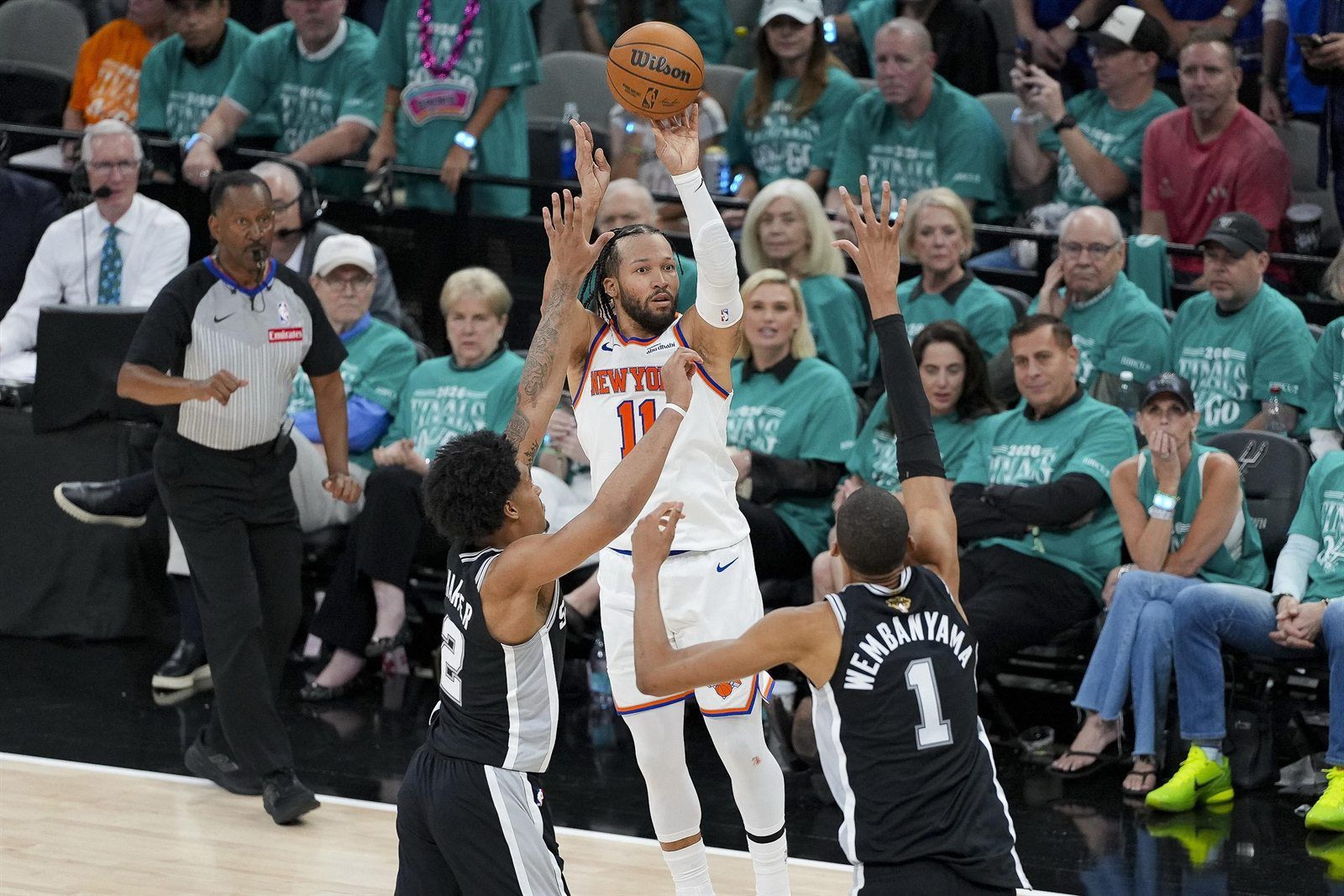
The New York Knicks beat the San Antonio Spurs 105-95 in Game 1 of the 2026 NBA Finals.
The easy version of the story is dramatic: Jalen Brunson was tougher in the final minutes, and Victor Wembanyama learned a Finals lesson.
That is not wrong, but it is incomplete.
New York did not win only because Brunson became a late-game superhero. San Antonio did not lose only because Wembanyama had a bad night. The Knicks won because they dragged the game into a closing environment they understood better: half-court pressure, physical rebounding, clean late-clock roles and one elite guard who could still create a shot when the structure broke.
The Spurs, meanwhile, looked young in the exact way young Finals teams often look young. Their talent was obvious. Their late-game hierarchy was not.
The Verified Game 1 Picture
| Category | What happened |
|---|---|
| Game | 2026 NBA Finals, Game 1 |
| Date | June 3, 2026 |
| Venue | Frost Bank Center, San Antonio |
| Final score | Knicks 105, Spurs 95 |
| Series | Knicks lead 1-0 |
| Key swing | San Antonio led by 14 in the second half; New York finished on an 11-0 run |
| Knicks leaders | Jalen Brunson: 30 points; Karl-Anthony Towns: 18 points, 12 rebounds; OG Anunoby: 17 points |
| Spurs leaders | Victor Wembanyama: 26 points, 12 rebounds, 6-for-21 shooting; Stephon Castle: 17 points; Dylan Harper and Julian Champagnie: 16 each |
AP reported that Brunson scored 13 points in the fourth quarter, only six fewer than the Spurs scored as a team in the period. Wembanyama, for his part, did not hide from the result. After the game, he acknowledged that he had played badly.
That honesty matters. The tape shows why.
What the Source Commentary Gets Right, and What Needs Refining
The video argues that Wembanyama came out too focused on showing his individual offense, that San Antonio's ball movement suffered, and that Brunson's closing ability punished the Spurs.
There is a real basketball point there. But the language needs to be sharpened.
| Emotional version | Better basketball version |
|---|---|
| Brunson taught Wembanyama a lesson | Brunson had the more mature closing game in the final five minutes |
| Wembanyama disrespected the game | Wembanyama's shot profile and decision-making narrowed San Antonio's offense |
| The Spurs followed Wembanyama's bad example | San Antonio's young offense became too static when its primary star hunted difficult shots |
| Towns proved he is a top defensive big | Towns gave New York enough physicality, spacing and rebounding to make Wembanyama work in multiple zones |
| Brunson is automatically the best clutch player in the league | In this game, Brunson was the clearest late-game shot creator on the floor |
The difference matters. A publishable analysis should not turn one bad Finals game into a character trial. It should explain the basketball choices that made the game tilt.
The Knicks Won the Final Five Minutes Before They Arrived
Brunson's late shots will be remembered first.
San Antonio went up 95-94 on Wembanyama free throws with 2:16 left. Brunson answered with a corner three on the next possession, putting New York ahead for good. The Knicks closed the game on an 11-0 run.
But Brunson's closing burst was possible because New York had already done three important things.
1. The Knicks Survived the 14-Point Hole
The Spurs led by 14 midway through the third quarter. In a Finals road game, that is usually where a team either loses contact or proves it can stay emotionally organized.
New York stayed organized.
The Knicks finished the third quarter on a 22-9 run and entered the fourth tied at 76. That changed the game. Instead of letting San Antonio's young roster ride a home-court wave, the Knicks turned the final period into a half-court possession contest.
That is New York's comfort zone.
2. Karl-Anthony Towns Made Wembanyama Defend Decisions
Brunson was the closer, but Towns was one of the reasons New York reached closing time.
Towns' 18 points and 12 rebounds matter, but his broader value was spatial. Against Wembanyama, many bigs create only one problem. Towns created several:
- he pulled Wembanyama away from the rim;
- he battled enough on the glass to prevent easy Spurs control;
- he made San Antonio decide when to switch, help or stay home;
- he kept New York's offense from shrinking.
That does not mean Towns "outclassed" Wembanyama as a player. It means he made Wembanyama spend attention in uncomfortable places.
That is a win in itself.
3. New York Had a Cleaner Closing Map
In the final minutes, the Knicks knew the basic order:
- Brunson creates;
- Towns spaces, screens or punishes a matchup;
- Anunoby defends and finishes;
- Josh Hart and the wings fight for possessions;
- everyone else stays ready.
The Spurs had talent, but their order was less stable. Some possessions ran through Wembanyama, some through guards, some through late-clock improvisation.
That is not shocking for a young Finals team. But it is expensive.
Wembanyama's Problem Was Not His Point Total
Wembanyama finished with 26 points and 12 rebounds. On paper, that is not a disaster.
The issue was efficiency and shape. He shot 6-for-21, and the offense around him often became narrow.
Wembanyama is most terrifying when he is not simply holding the ball and proving he can shoot over a defender. His best version combines:
- early deep catches;
- movement into space before the catch;
- high-post passing;
- rolls and slips after screens;
- rim pressure that forces help;
- defensive dominance that creates transition chances.
When he settles into too many face-up jumpers and isolated possessions, the defense can breathe. Weak-side defenders stop rotating. Teammates begin watching. The Spurs' possession becomes a difficult Wembanyama shot rather than a team problem for New York.
That is the lesson from Game 1.
Wembanyama does not need fewer touches. He needs better touches.
San Antonio's Young Players Were Not the Problem
The Spurs did have real positives.
NBA Communications noted that Dylan Harper scored 16 points, setting the Spurs rookie record for most points in an NBA Finals game. Harper also scored 10 in the first quarter, a rare rookie Finals burst in the play-by-play era.
Julian Champagnie made five threes in the first half, setting a Spurs franchise record for threes in a Finals half.
Stephon Castle added 17 points.
That matters because it complicates the easy blame story. San Antonio did not lose because nobody helped Wembanyama. San Antonio lost because the offense did not turn those moments into a stable closing system.
Young production is good. Late-game organization is different.
What the Spurs Should Change in Game 2
San Antonio does not need to panic. The Spurs led by 14 and still have the best long-term talent in the series.
But they do need a cleaner plan.
| Game 1 issue | Game 2 adjustment |
|---|---|
| Wembanyama took too many difficult self-created looks | Get him touches earlier in the clock and closer to the rim |
| Teammates watched when he held the ball | Add weak-side cuts and second-side movement |
| Knicks pulled Wembanyama away from the basket | Use clearer help rules and pre-rotations behind him |
| Brunson controlled the final minutes | Change coverages earlier in the fourth, not only after he heats up |
| Spurs relied on talent late | Build two or three dependable crunch-time actions with Fox and Wembanyama |
The last point is the biggest.
Finals possessions punish vagueness. If the Spurs wait until the final two minutes to decide who they are, Brunson will keep getting the kind of game he likes.
Why Brunson's Game Was More Impressive Than the Box Score
Brunson's 30 points were not a perfect shooting exhibition.
That is why the performance was impressive.
Finals closers rarely get clean conditions. They absorb contact. They miss shots. They see different coverages. They have to keep making decisions after previous decisions failed.
Brunson did that. He accepted the messy parts of the game and still delivered the late answers.
That is a major difference between being talented and being ready to close a Finals game.
Wembanyama is more physically gifted than anyone in the series. Brunson was more settled in Game 1's final moments.
That was enough.
The Real Meaning of Game 1
Game 1 was not a career referendum on Wembanyama. It was not proof that Brunson is invincible. It was the first answer to the central question of the series:
When the game slows down, whose offense becomes clearer?
In Game 1, the answer was New York.
The Knicks stole home-court advantage because they had the cleaner closing map, the more reliable late-game creator and enough size to make Wembanyama work for every advantage.
The Spurs can adjust. They are too talented not to.
But Game 2 will ask Wembanyama and San Antonio for something more specific than greatness. It will ask for structure.
FAQ
Who won Game 1 of the 2026 NBA Finals?
The New York Knicks beat the San Antonio Spurs 105-95 in San Antonio and took a 1-0 series lead.
How many points did Jalen Brunson score?
Brunson scored 30 points, including 13 in the fourth quarter. New York finished the game on an 11-0 run.
Was Victor Wembanyama bad in Game 1?
He still had 26 points and 12 rebounds, but he shot 6-for-21 and did not control the game efficiently. His shot selection and San Antonio's late-game structure are the real concerns.
What did Karl-Anthony Towns do well?
Towns had 18 points and 12 rebounds, but his biggest impact was making Wembanyama defend in space, battle physically and make repeated decisions away from the rim.
What is the Spurs' biggest Game 2 adjustment?
They need to give Wembanyama better touches, not just more touches. Earlier catches, more movement, more two-man actions and less late-clock isolation should be priorities.