Roger Federer's 2017 season is often described as a fairytale.
That is fair. He was 35, coming off knee surgery, returning after a six-month layoff, and had not won a major title since Wimbledon 2012. In elite tennis terms, the more reasonable expectation was a graceful late-career stretch, not another Grand Slam surge.
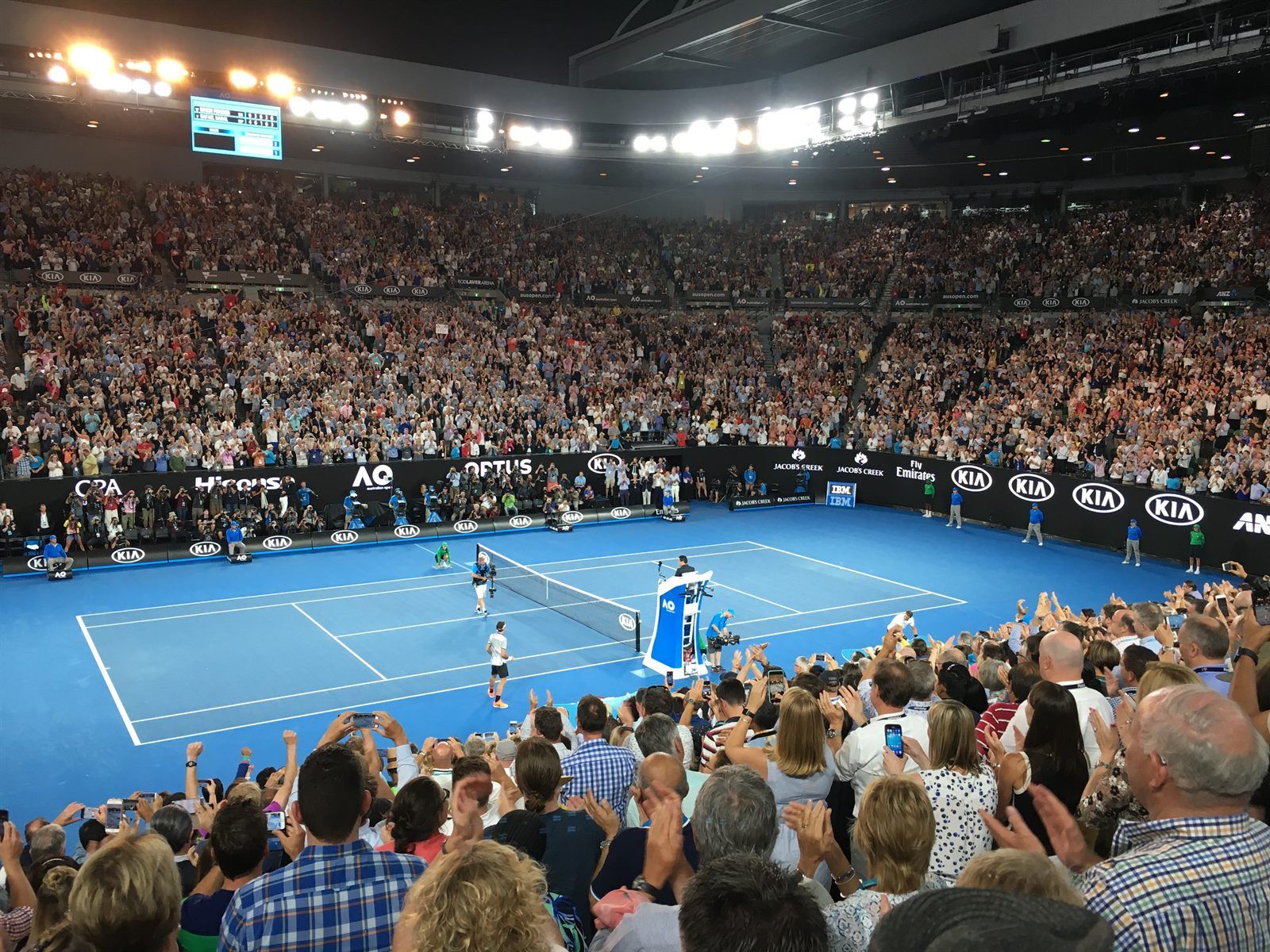
Then Federer won the Australian Open, Indian Wells, Miami, Halle, Wimbledon, Shanghai and Basel. He took his major count from 17 to 19 and made the late chapter of his career feel newly alive. ATP's report from the 2017 Australian Open final confirms that Federer defeated Rafael Nadal 6-4, 3-6, 6-1, 3-6, 6-3 to win his 18th major title. ATP: Federer beats Nadal at Australian Open 2017
But if we only call it emotional, we miss the more useful lesson.
Federer's 2017 was not a simple return to youth. It was a late-career redesign: a player accepting physical limits, improving specific patterns, managing his schedule more sharply, and building one more championship window.
The Short Answer
| Area | What changed in 2017 | Why it mattered |
|---|---|---|
| Body | Returned after knee surgery and a long layoff | The comeback started from interruption, not continuity |
| Backhand | Took the ball earlier and attacked more often | Reduced Nadal's high-topspin pressure |
| Court position | Played closer to the baseline | Shortened time and rallies |
| Scheduling | Skipped the clay season | Protected his body for grass and hard courts |
| Results | Australian Open, Sunshine Double, eighth Wimbledon | Proved the comeback was repeatable |
| Legacy | Added two majors in 2017 and another in 2018 | Rewrote the ending of his career |
Federer did not become the 2006 version of himself again. He became a smarter, more selective and more efficient version of an older Federer.
2017 Timeline
| Time | Event | Why it matters |
|---|---|---|
| February 2016 | Federer underwent knee surgery | First major physical interruption of his career |
| July 2016 | Ended his season after Wimbledon | The six-month break raised questions about decline |
| January 2017 | Beat Nadal to win the Australian Open | First major title in almost five years |
| March 2017 | Beat Stan Wawrinka to win Indian Wells | ATP noted that his backhand became a major talking point |
| April 2017 | Beat Nadal in the Miami final | Completed his third Sunshine Double |
| Spring 2017 | Skipped the clay season | Focused resources on grass and hard courts |
| July 2017 | Won Wimbledon without dropping a set | Eighth Wimbledon and 19th major title |
| October 2017 | Beat Nadal again to win Shanghai | Confirmed the matchup shift was not accidental |
| January 2018 | Won the Australian Open again | Extended the comeback into a late-career peak |
ATP's Miami report confirms that Federer defeated Nadal 6-3, 6-4 in the 2017 final and completed his third Sunshine Double. ATP's Wimbledon report confirms that he defeated Marin Cilic to win a record eighth Wimbledon title and became the oldest men's Wimbledon champion of the Open Era. ATP Miami 2017, ATP Wimbledon 2017
Why the 2016 Low Point Matters
Comeback stories often start with the trophy, but Federer's 2017 starts with 2016.
The knee injury did not merely interrupt his form. It forced him to confront surgery, recovery, a paused schedule and the reality of aging. For a younger player, six months away from the tour is a risk. For a 35-year-old, it can become the beginning of the end.
Federer turned that break into a rebuild.
That is one reason the 2017 season mattered so much. The visible story was romantic. The hidden story was practical: he finally had enough time to reconsider the relationship between body, technique and calendar.
The Backhand Was Not a Detail
Federer's one-handed backhand is one of the sport's most beautiful strokes. Against Nadal, however, it had long been attacked.
Nadal's left-handed forehand topspin repeatedly drove the ball high into Federer's backhand side. If Federer retreated and waited, he often had to hit from uncomfortable contact points. Nadal could then keep using the same pattern until he gained control.
In 2017, Federer changed the terms.
| Adjustment | Old problem | 2017 solution |
|---|---|---|
| Earlier contact | Waiting let the ball jump high | Took the ball sooner and robbed Nadal of time |
| More aggressive backhand | Passive slices and neutral blocks invited pressure | Drove the ball flatter and more directly |
| Shorter points | Long exchanges favored younger legs and Nadal's physical pressure | Used serve, first strike and net play to reduce cost |
| Faster tempo | Slow rhythm moved toward Nadal's comfort zone | Made the match a time-pressure problem |
ATP's 2017 Indian Wells final report specifically noted that Federer's backhand had become a talking point of the tournament. ATP Indian Wells 2017
This was not just a hot streak. It was a technical redesign suited to a 35-year-old body.
Why the Australian Open Fifth Set Matters
The 2017 Australian Open final was emotional because it reunited Federer and Nadal in a major final. Its deeper significance came in the fifth set.
Federer trailed 1-3. In many earlier Federer-Nadal matches, that script would have moved toward Nadal's preferred territory: longer rallies, heavier topspin and sustained physical pressure. This time Federer did not retreat into the old pattern. He kept taking time away, kept trusting the backhand, and kept trying to shorten the match on his terms.
That win mattered on three levels:
- It gave Federer his 18th major title.
- It proved the new tactical approach could survive maximum pressure.
- It changed the psychological tone of the Federer-Nadal matchup in 2017.
That is why Melbourne was not merely a sentimental championship. It was a system test.
The Sunshine Double Proved It Was Repeatable
If Federer had only won the Australian Open, 2017 would still be moving, but it might look like one perfect emotional peak.
Indian Wells and Miami changed the interpretation.
Those back-to-back Masters events demand recovery, movement, serve quality and mental sharpness. Federer beat Wawrinka in the Indian Wells final and Nadal in the Miami final. ATP's Miami report confirms it was his third Sunshine Double, after 2005 and 2006.
That made the comeback look repeatable, not accidental.
| Tournament | Final opponent | Value |
|---|---|---|
| Australian Open | Rafael Nadal | Historical and emotional breakthrough |
| Indian Wells | Stan Wawrinka | Proof the level carried into Masters events |
| Miami | Rafael Nadal | Confirmation that the matchup adjustment worked again |
| Wimbledon | Marin Cilic | Full-circle triumph at his signature venue |
Skipping Clay Was a Competitive Decision
One of Federer's smartest 2017 moves was not a shot. It was an absence.
He skipped the clay season.
Clay produces longer rallies, heavier physical demand and less natural reward for late-career Federer's first-strike style. Skipping it reduced exposure, but it protected the resources that mattered most: health, speed and explosiveness.
This is a mature veteran decision. Young champions often prove themselves by playing everything. Older champions often survive by knowing what not to play.
The Wimbledon result made the logic clear.
Wimbledon: The Fairytale Closes the Loop
Wimbledon is the central stage of Federer's career.
He won his first major there in 2003. He won his 17th major there in 2012. In 2017, he returned to win his eighth Wimbledon title and 19th major.
ATP's Wimbledon report confirms that Federer defeated Marin Cilic and became the oldest men's Wimbledon champion of the Open Era. The title was also striking because Federer did not drop a set throughout the tournament.
That gave 2017 its full structure:
- Australian Open: rebirth;
- Sunshine Double: validation;
- Wimbledon: return to his natural throne.
What Late-Career Athletes Can Learn
Federer's 2017 is not a simple motivational template, but it does offer useful lessons.
| Lesson | Federer's example | Broader meaning |
|---|---|---|
| Accept change | He did not pretend to be 25 | Limits must be named before they can be solved |
| Keep the core | Serve, first strike and grass-court instincts remained central | Reinvention does not mean abandoning strengths |
| Fix the repeated problem | The backhand answered Nadal's high topspin more directly | Old problems need new answers |
| Manage the calendar | He skipped clay to protect the grass campaign | Selection can matter more than endurance |
| Reduce cost | Shorter points lowered physical load | Efficiency becomes a late-career weapon |
That is what makes this comeback more interesting than "never give up." Federer did not overpower time. He redistributed it.
The Boundary: Do Not Over-Mystify 2017
High-quality sports writing should keep the romance, but also keep the boundary.
Federer's 2017 was extraordinary, but it did not permanently defeat aging. After the 2018 Australian Open, he never won another major. He came very close at Wimbledon 2019, then finally retired after playing doubles with Nadal at the 2022 Laver Cup.
ATP's retirement release lists Federer's final resume: 20 major titles, 103 tour-level titles, 310 weeks at world No. 1, a record 237 consecutive weeks at No. 1, and 28 Masters 1000 titles. ATP Federer retirement release
So 2017 was not eternal rebirth. It was a window created with rare precision. That is exactly why it remains so valuable.
FAQ
Was Federer's 2017 comeback only emotional?
No. Emotion made it memorable, but the wins came from real changes: earlier backhand contact, better court position, more efficient points, careful scheduling and improved physical management.
Did he return to his absolute prime?
No. He did not recreate the full-season dominance of 2004-07. He built a more efficient late-career style that could peak at the right events.
Was skipping clay a sign of weakness?
No. It was strategic resource management. For an older Federer, playing every event was less important than arriving at Wimbledon with the right body and rhythm.
Did 2017 change Federer's legacy?
Yes. It turned his late career from a graceful decline into a second creative act. His final major count stopped at 20, but 2017 changed the emotional and tactical meaning of that total.
Conclusion
Federer's 2017 really was a fairytale.
An elegant champion returned from injury, beat Nadal in Melbourne, won the Sunshine Double, skipped the clay season, and lifted the Wimbledon trophy again. That is sports romance at its cleanest.
But the deeper value is not magic.
It is a manual for late-career excellence: accept the body has changed, protect the weapons that still work, solve the matchup problem that keeps repeating, choose the right battles, and spend physical resources where they matter most.
Federer did not prove that genius never ages.
He proved something more interesting: genius ages too, but the very best athletes can still find another way to win.