The 2022 World Cup final is often called epic. That is true, but not specific enough.
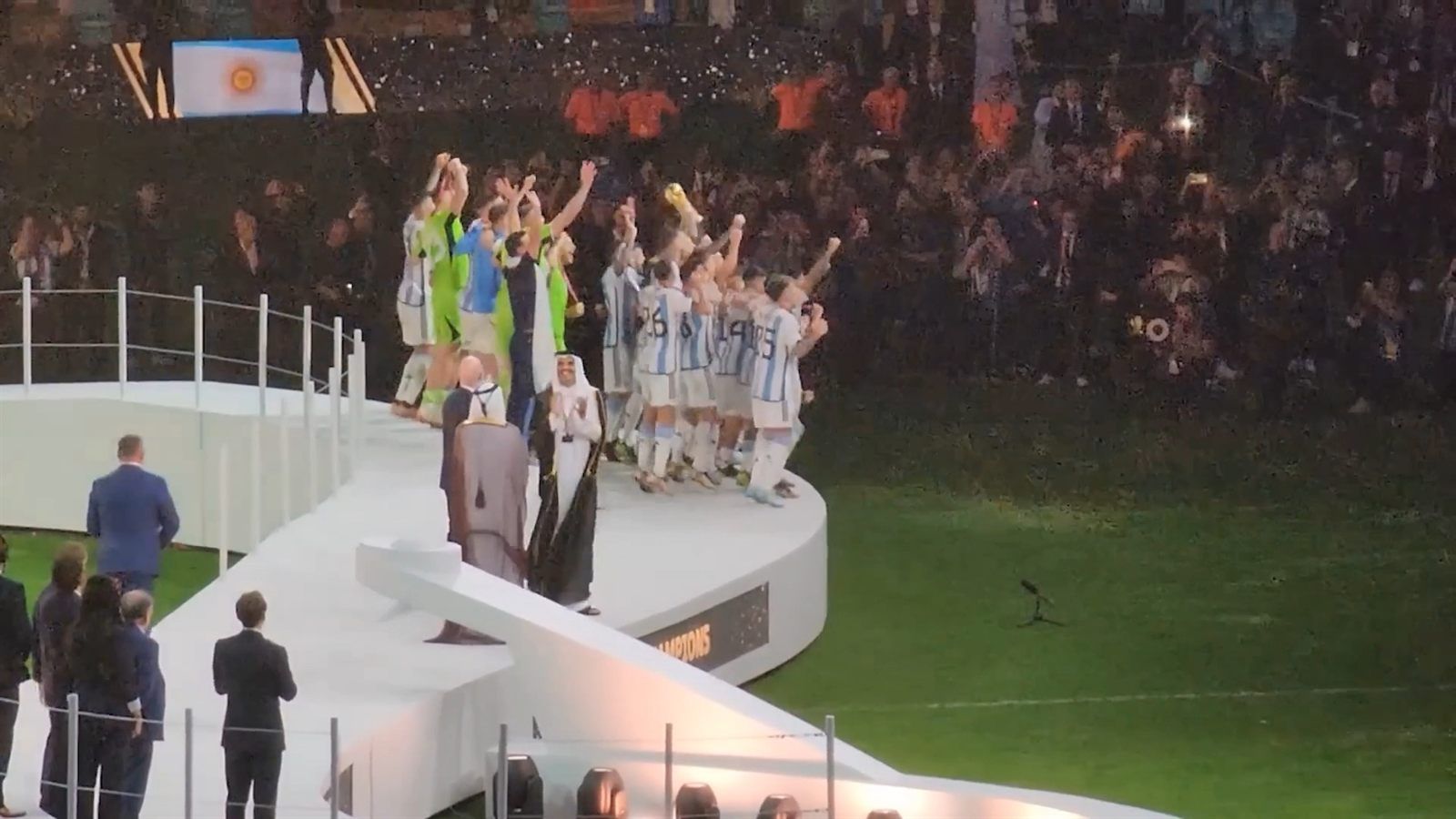
Argentina 3-3 France, with Argentina winning 4-2 on penalties, had every dramatic ingredient: Lionel Messi's coronation, Kylian Mbappe's hat-trick, a two-goal lead erased, an extra-time lead erased again, and a penalty shootout to decide the trophy.
But the match is more valuable than a dramatic recap. It is a complete case study in modern football: tactical preparation, matchup targeting, physical decline, substitution correction, superstar pressure, goalkeeper psychology, and emotional recovery.
This article asks a sharper question: why did this final become a model for the modern World Cup final?
Match Facts
| Item | Detail |
|---|---|
| Match | 2022 FIFA World Cup final |
| Result | Argentina 3-3 France; Argentina won 4-2 on penalties |
| Date and venue | 18 December 2022, Lusail Stadium |
| Attendance | 88,966 |
| Argentina goals | Messi 23' penalty, Di Maria 36', Messi 108' |
| France goals | Mbappe 80' penalty, 81', 118' penalty |
| Awards | Messi Golden Ball, Mbappe Golden Boot, Emiliano Martinez Golden Glove, Enzo Fernandez Best Young Player |
FIFA's full-time match report confirms the score, penalty result, venue, date, and attendance. FIFA full-time match report
The Four Phases of the Final
| Phase | Time | What happened | Why it mattered |
|---|---|---|---|
| Argentina control | Roughly 0-70 minutes | Argentina led 2-0 and France struggled to progress | Di Maria attacked the left side, Argentina's midfield cut passing lanes |
| France restart | 70-90 minutes | Mbappe scored in the 80th and 81st minutes | Argentina's pressure dropped, France's substitutions added speed |
| Extra-time duel | 90-120 minutes | Messi made it 3-2, Mbappe made it 3-3 | Both superstars took control of critical moments |
| Penalty decision | Shootout | Argentina won 4-2 | Emiliano Martinez affected rhythm, Argentina executed better |
The match was not only a comeback story. It was a sequence of tactical control, game-state collapse, recovery, and psychological survival.
Why Argentina Controlled France
Argentina's opening dominance was not random emotion.
Lionel Scaloni's key decision was to use Angel Di Maria on the left, where his one-on-one ability could attack France's right side. Di Maria won the penalty for the first goal and scored the second. That was not sentimental selection. It was precise targeting.
Argentina's midfield was just as important. Rodrigo De Paul, Alexis Mac Allister, and Enzo Fernandez disrupted France's central progression. Antoine Griezmann could not turn comfortably between lines, and Kylian Mbappe did not receive the ball in spaces where he could sprint into the game.
FIFA's technical report shows the structure behind the control. Argentina completed 544 of 648 passes, while France completed 419 of 516. Argentina completed 146 line breaks to France's 94, and Argentina had 163 receptions in the final third to France's 69. FIFA Training Centre technical report
Those numbers do not mean Argentina attacked constantly for 120 minutes. They show that Argentina more often moved the ball into zones where France had to defend real danger.
Why Di Maria Was the First Key
Messi and Mbappe dominate the memory of the final, but Di Maria shaped the first half.
| Value | How it appeared |
|---|---|
| One-on-one pressure | He repeatedly attacked France's right side |
| Width | He stretched the French back line and opened central space |
| End product | He won the first penalty and finished the second goal |
France wanted to use speed to pressure Argentina. Instead, Di Maria made France's right side spend the first half reacting.
How France Came Back
France looked trapped for most of the match, but Didier Deschamps changed the game with aggressive substitutions.
Removing Olivier Giroud and Ousmane Dembele before half-time was almost an admission that the first plan had failed. Later, Marcus Thuram, Randal Kolo Muani, Kingsley Coman, and Eduardo Camavinga added more running power and vertical threat.
When Argentina's pressure weakened, France finally found direct attacking space. Mbappe's penalty in the 80th minute reopened the final. His volley a minute later changed the emotional gravity of the match.
That is what made France dangerous. They did not need long control. They needed a small crack, and Mbappe turned it into a crisis.
Messi and Mbappe: Two Kinds of Greatness
| Player | Final role | Signature contribution | Meaning |
|---|---|---|---|
| Lionel Messi | Controller and finisher | Penalty goal, extra-time goal, involvement in Argentina's second goal | The old master completed the World Cup chapter |
| Kylian Mbappe | Breaker and rescuer | Goals in the 80th, 81st, and 118th minutes | The next era announced itself even in defeat |
Messi's greatness was control. He slowed the game, connected lines, attracted defenders, and still finished the biggest moments.
Mbappe's greatness was rupture. He was quiet for long stretches, but once the match opened, his speed, shooting, and nerve dragged France back from the edge.
FIFA's awards reflected this double story: Messi won the Golden Ball and Mbappe won the Golden Boot. FIFA Golden Ball page, FIFA Golden Boot page
What the Official Numbers Say
| Metric | Argentina | France | Meaning |
|---|---|---|---|
| Attempts / on target | 21 / 11 | 10 / 5 | Argentina created more shooting volume and more accurate attempts |
| Corners | 6 | 5 | Set-piece volume was close |
| Penalties | 1 / 1 | 2 / 2 | Two of France's three goals came from penalties |
| Fouls | 26 | 19 | The match had high physical and emotional pressure |
| Yellow cards | 5 | 3 | Argentina defended close to the edge late on |
| Completed passes | 544 | 419 | Argentina's possession structure was more stable |
| Final-third receptions | 163 | 69 | Argentina reached dangerous areas more often |
The numbers clarify something emotion can hide: Argentina did not steal the final. They were structurally better for long periods. France's achievement was different: they were outplayed for much of the match and still forced the final to its limit.
Penalties and the Psychology of Not Breaking
Argentina's hardest task was not taking the lead. It was surviving after the lead disappeared.
They went from 2-0 to 2-2. Then they went from 3-2 to 3-3. Many teams collapse when a final repeatedly tells them that destiny is slipping away.
Argentina did not.
In the shootout, Messi, Paulo Dybala, Leandro Paredes, and Gonzalo Montiel scored. For France, Kingsley Coman was denied by Martinez and Aurelien Tchouameni missed.
Martinez's value was not only shot-stopping. In a shootout, a goalkeeper can create time pressure, emotional pressure, and spatial doubt. Argentina's goalkeeper did that at the highest possible moment.
What This Final Changed
For Messi, it closed the largest gap in his career. The World Cup title ended the split between club greatness and national-team longing.
For Argentina, it completed a long emotional arc: the 2014 final defeat, the Copa America losses, Messi's brief international retirement, the 2021 Copa America win, and finally the 2022 World Cup.
For France, defeat did not end the era. Mbappe's hat-trick showed that he was already more than a future star. He was a present-tense World Cup final force.
For the World Cup, the match became a near-complete modern final: tactical clarity, statistical contrast, emotional collapse and recovery, two generational stars, and a penalty shootout.
FAQ
Why is this final often called one of the greatest World Cup finals?
Because it combined elite tactical conflict, superstar performance, repeated score swings, extra-time goals, penalties, and historic meaning. Many finals have one or two of those elements. This one had almost all of them.
Did Argentina win only because of Messi?
No. Messi was central, but Argentina also needed Di Maria's left-side impact, midfield pressing, Mac Allister's and Enzo's progression, Martinez's shootout presence, and collective recovery after two blown leads.
Why did France struggle for so long?
France's central links were disrupted, Griezmann could not organize comfortably, Mbappe lacked running space, and Di Maria attacked France's right side. The game changed only after substitutions increased France's speed and verticality.
Why did Mbappe's reputation rise despite losing?
Because he scored a World Cup final hat-trick while his team was close to defeat. He did not win the trophy, but he played like a generational centerpiece.
Are penalties just luck?
Luck matters, but penalties are also about technique, order, pressure, fatigue, goalkeeper behavior, and emotional control. Argentina managed those details better.
Conclusion
If this final were only Messi's coronation, it would already be memorable.
But its greatness is its completeness.
It had Argentina's preparation, Di Maria's matchup attack, France's failed first plan, Deschamps' correction, Mbappe's eruption, Messi's final answer, and Martinez's penalty psychology.
Argentina did not cruise to the trophy. They survived the moment when the match seemed determined to break them. France did not simply lose. They pushed a lost final to the edge of immortality.
That is why Argentina 3-3 France is more than a scoreline.
It is a modern World Cup final in full: tactics, stamina, psychology, stars, history, and fate all pushed to maximum intensity.