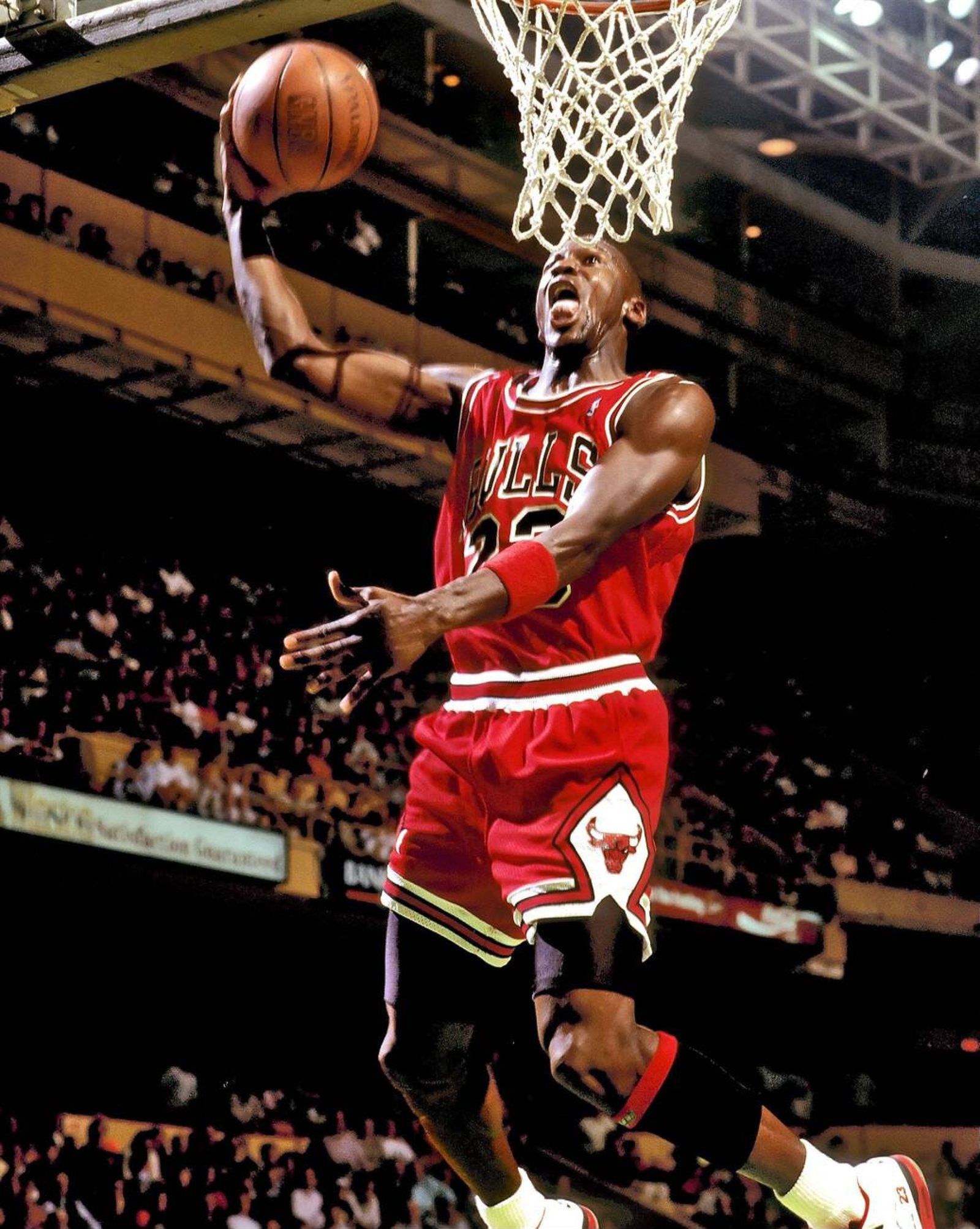
Michael Jordan's career is often told like a myth: the high school slight, the North Carolina shot, the rise in Chicago, the battles with Detroit, two three-peats, and the final jumper in Utah.
But repeating those moments is not enough. A more useful question is this: why does Jordan still function as the standard in basketball's GOAT debate?
The answer is not only "six rings." It is the combination of peak dominance, playoff translation, skill evolution, championship structure, cultural influence, and career narrative.
Jordan is not simply remembered as a great player. He became a measuring device.
The Short Version: Why Jordan's Case Is So Strong
| Evaluation area | Jordan's strongest point | Why it matters |
|---|---|---|
| Peak dominance | Elite scoring, defensive pressure, and late-game shot creation | GOAT debates should measure how high a player's best level reached |
| Playoff translation | Six NBA titles and six Finals MVPs | The greatest players must carry regular-season value into the highest-pressure games |
| Skill evolution | From explosive slasher to post-up and midrange master | His greatness was not based only on athleticism |
| Team fit | Became the central weapon inside the triangle offense | Individual dominance had to become championship basketball |
| Commercial impact | Air Jordan changed athlete branding and sneaker culture | Jordan changed how basketball was consumed globally |
| Narrative completeness | Failure, ascent, retirement, comeback, second dynasty | Few careers have such a complete dramatic arc |
NBA.com summarizes the scale of his resume with five MVPs, six championships, six Finals MVPs, ten scoring titles, Defensive Player of the Year, and 14 All-Star selections, while also noting how he redefined the NBA superstar. NBA.com's Michael Jordan profile
Career Timeline: The Upgrades Behind the Myth
| Stage | Key moment | Why it matters |
|---|---|---|
| North Carolina | In 1982, Jordan hit a key shot as UNC beat Georgetown 63-62 for the NCAA title | His first national-stage identity was built on a pressure shot |
| Rookie rise | Drafted third overall in 1984 by Chicago | Jordan immediately changed the Bulls' relevance |
| Early playoff pain | Celtics and Pistons exposed the gap between scoring brilliance and championship control | Failure forced his game to mature |
| First three-peat | 1991 to 1993 titles | He became the league's championship center |
| Baseball retirement | Left the NBA after his father's death | The myth gained a human interruption |
| Second three-peat | 1996 to 1998 titles | He proved the comeback was not nostalgia |
| Washington years | Returned with the Wizards from 2001 to 2003 | This made the ending less perfect, but more human |
NCAA.com records North Carolina's 63-62 win over Georgetown in the 1982 championship game, the moment that placed freshman Jordan on the national map. NCAA 1982 tournament recap
Why the Numbers Still Matter
Jordan's ring count is famous, but the better case is not only about rings. It is about how often his production survived the move from regular season to postseason to Finals.
| Category | Jordan's marker | Interpretation |
|---|---|---|
| Career scoring average | 30.1 points per game, with 6.2 rebounds and 5.3 assists | Basketball-Reference lists a career profile that still reads like a peak season |
| Scoring titles | 10 | Long-term scoring control, not a short burst |
| Regular-season MVPs | 5 | League-wide recognition across multiple seasons |
| Finals MVPs | 6 | Every Bulls title had Jordan as the Finals centerpiece |
| Defensive honors | 1988 Defensive Player of the Year and nine All-Defensive First Team selections | The case is not offense-only |
One important update matters in 2026: Jordan is no longer fifth on the NBA's all-time regular-season scoring list. ESPN reported that Kevin Durant passed him in March 2026. ESPN on Durant passing Jordan
That does not weaken Jordan's core argument as much as it clarifies it. His GOAT case is not built on accumulation alone. It is built on peak dominance, playoff translation, and championship completeness.
Why Detroit Was Necessary
The Detroit Pistons are often treated as villains in Jordan's rise, but they were also his most important obstacle.
Early Jordan could score on anyone, yet the Bulls could not get past Detroit. NBA.com identifies the Pistons' defensive approach under Chuck Daly and his staff as the "Jordan Rules," a strategy built on physicality, help defense, and forcing Jordan to solve too much by himself. NBA.com's Jordan profile
Those losses changed him.
He got stronger. He learned to survive contact. He trusted teammates more. He became more dangerous without the ball and more patient in the half court.
When Chicago finally beat Detroit in 1991, it was not only revenge. It was proof that Jordan had moved from individual brilliance to championship leadership.
The Second Three-Peat Explains the First One
Young Jordan was defined by explosion: first step, hang time, drives, dunks, transition attacks. That version was spectacular, but it was not the whole player.
The second three-peat Jordan was different. He posted up more. He used footwork, shoulder fakes, turnarounds, fadeaways, and midrange rhythm. He no longer needed to win every possession through raw burst.
That matters because the best players are not only great at one age. They find ways to remain great as the body changes.
Jordan's late-Bulls version made his early-Bulls version more convincing. It showed that his greatness was not just athletic superiority. It was adaptation.
Air Jordan and the Business of Immortality
Jordan's legacy also lives outside the box score.
Nike's Air Jordan 1 archive lists the original release year as 1985, the designer as Peter Moore, and the original price as $65. Nike Air Jordan 1 archive
That shoe became more than equipment. It connected basketball, advertising, streetwear, identity, and aspiration. Jordan helped turn the athlete into a global cultural product.
This is an underrated part of his GOAT case. Jordan did not only dominate basketball. He changed the commercial language around basketball.
The Limits of the Jordan Argument
A serious article should not treat Jordan's case as untouchable.
There are real limits.
First, eras are different. Defensive rules, three-point volume, spacing, training, medical care, and player movement all changed after Jordan's prime.
Second, accumulation is not his strongest category. His retirements and Wizards years mean that his total points, assists, rebounds, and longevity markers are not as dominant as those of some later superstars.
Third, the Bulls dynasty was not a solo project. Scottie Pippen, Phil Jackson, Dennis Rodman, Horace Grant, Toni Kukoc, Tex Winter's triangle principles, and the front office all mattered.
None of this destroys Jordan's case. It makes the case more accurate.
Jordan was not great because context did not exist. He was great because he became the highest-functioning player inside a context built to win.
A Better Way to Compare Jordan
Instead of asking only "Who has more rings?" or "Who has more points?", a better comparison framework asks:
| Question | Purpose |
|---|---|
| Was he clearly above his own era? | Measures era-relative dominance |
| Did his regular-season value survive the playoffs? | Measures pressure translation |
| Did he adapt as rules, age, and roster context changed? | Measures sustainability |
| Did he raise the ceiling of a championship system? | Measures team impact |
| Did he change the sport beyond the court? | Measures cultural and commercial influence |
| Do the weaknesses overturn the main case? | Keeps the debate honest |
Jordan scores near the top in almost every category. That is why he remains a standard, not merely a memory.
FAQ
Why is Jordan so often called the GOAT?
Because his case combines peak dominance, playoff success, Finals performance, two-way impact, skill evolution, and cultural influence. The six titles and six Finals MVPs are central, but they are not the whole argument.
Was Jordan only great because of his teammates?
No. The Bulls dynasty absolutely depended on Pippen, Jackson, Rodman, Grant, Kukoc, and the triangle offense. But Jordan was the ceiling-raiser. The more accurate view is that his individual greatness and Chicago's system amplified each other.
Do the Wizards years hurt his legacy?
They make the ending less perfect and lower some career averages, but they do not redefine the Bulls prime. The Wizards years are an epilogue, not the central evidence.
Is Jordan clearly greater than LeBron James?
It depends on the criteria. Jordan's argument is peak dominance, Finals record, and cultural myth. LeBron's argument is longevity, all-around creation, and unmatched sustained value. They are not great in identical ways.
What is Jordan's least repeatable achievement?
The combination. Many players can approach one part of his legacy. Very few combine on-court dominance, championship drama, commercial transformation, and a nearly complete career narrative.
Conclusion
Jordan is mythologized, but he is not great only because of mythology.
Strip away the aura and the evidence remains: unmatched Finals resume, historic scoring peak, elite defense, technical adaptation, two three-peats, and a cultural footprint that changed the business of sports.
His career is powerful because each failure forced an upgrade. North Carolina gave him the first stage. Boston and Detroit taught him that scoring was not enough. The first three-peat made him the league's face. Retirement and return made the second three-peat feel almost impossible.
Jordan remains one of the strongest GOAT answers because his career is not just a list of achievements. It is a framework for what basketball greatness can mean.
He was a player.
He became the standard.