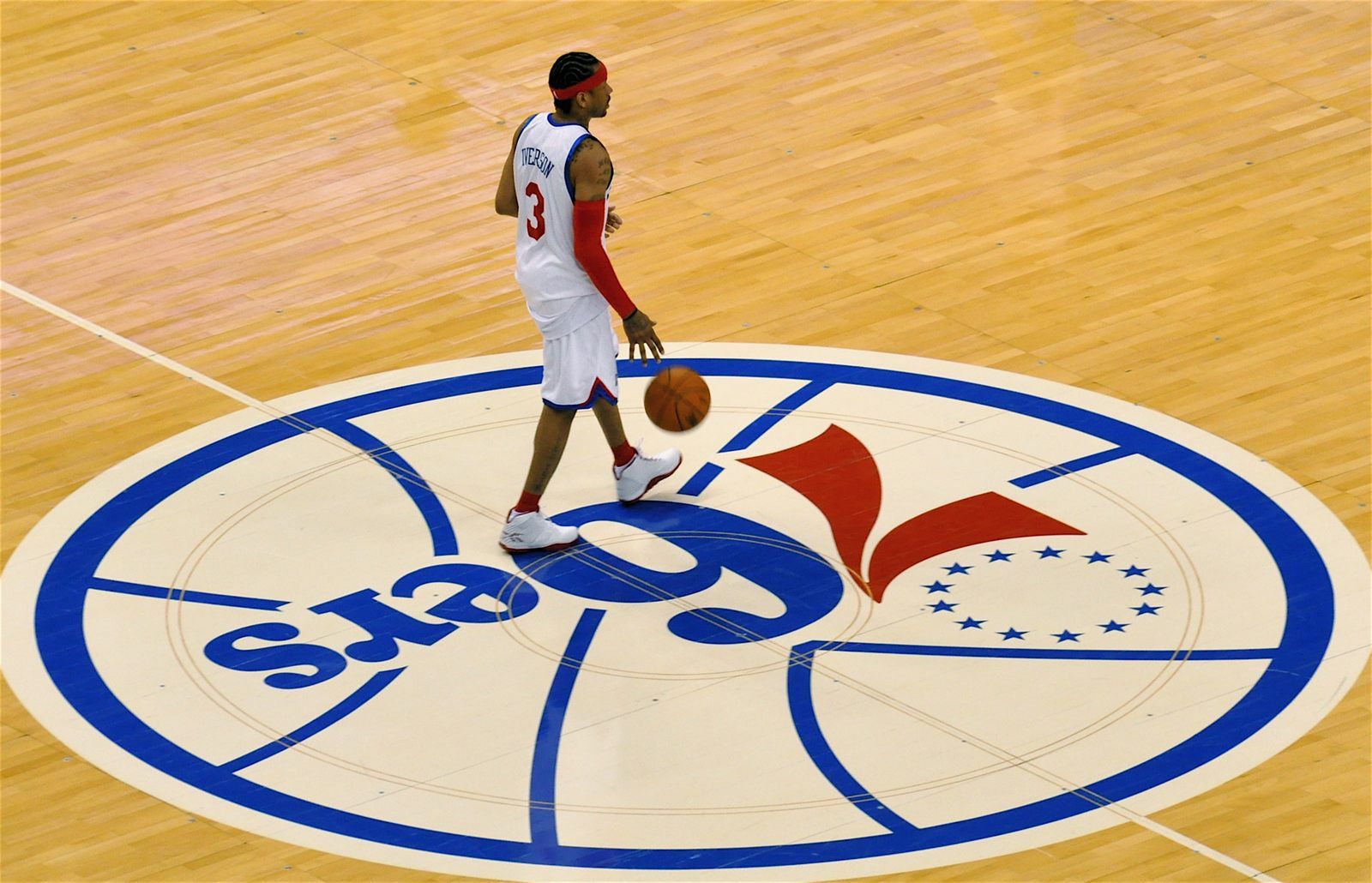
Allen Iverson is not easy to evaluate.
He never won a championship. He was not a traditional point guard. His efficiency is often questioned, and his shot selection remains part of the debate. At the same time, he was the 2001 MVP, a four-time scoring champion, an 11-time All-Star, and one of the most culturally influential guards in NBA history.
Iverson matters because he changed how basketball fans understand stardom. A small guard could become an offensive center. Street-influenced style could enter the NBA mainstream. A high-usage scorer could be inefficient by some standards and still be structurally irreplaceable to his team.
This article asks: why does Allen Iverson remain unavoidable in NBA history despite never winning a ring?
The Short Answer
| Evaluation area | Iverson's value | Where caution is needed |
|---|---|---|
| Resume | 2001 MVP, four scoring titles, 11 All-Star selections, seven All-NBA teams | Strong resume, but no championship |
| Size contrast | About six feet tall, yet carried elite scoring volume | Size mythology should not erase efficiency questions |
| Offensive function | Handle, burst, foul pressure, midrange, transition, self-creation | High usage created shot-selection problems |
| 2001 season | Took a defense-heavy Sixers team to the Finals | The system fit him, but also limited the offense |
| Cultural impact | Hair, tattoos, fashion, hip-hop identity, authenticity | Cultural importance is not the same as ranking |
| Legacy | Expanded the imagination for small guards and high-usage creators | Modern standards would judge him differently |
The Naismith Hall of Fame profile confirms Iverson's major honors: 2016 enshrinement, 11 All-Star selections, four scoring titles, 2001 MVP, 1997 Rookie of the Year, and more than 24,000 points with more than 5,000 assists. Naismith Hall of Fame: Allen Iverson
Career Facts
| Item | Detail |
|---|---|
| Born | June 7, 1975, Hampton, Virginia |
| Draft | No. 1 pick in 1996 by the Philadelphia 76ers |
| Major honors | 2001 MVP, four scoring titles, three steals titles, 11 All-Star selections |
| Career points | 24,368 |
| Career assists | 5,624 |
| Career regular-season averages | 26.7 points, 6.2 assists, 3.7 rebounds, 2.2 steals |
| Hall of Fame | Enshrined in 2016 |
StatMuse and Basketball-Reference search results list Iverson's 24,368 points, 5,624 assists, and 26.7 points per game career average. StatMuse career points
Why the 1996 No. 1 Pick Was a Challenge
The 1996 NBA Draft was loaded with talent: Kobe Bryant, Steve Nash, Ray Allen, Stephon Marbury, and others came from the same class. Iverson going first was already a challenge to traditional thinking.
The NBA still often preferred building around big men or physically standard perimeter stars. Iverson's size, style, personality, and cultural presentation did not fit the safe template.
His handle, speed, crossover, pull-up game, and ability to get into the lane immediately gave Philadelphia an offensive starting point. But the cost was also clear: he needed the ball, he needed teammates built around his limitations, and his shot diet would always create debate.
Iverson solved problems and created problems at the same time.
2001: Why the One-Star, Four-Defender Model Worked
The 2000-01 season was Iverson's peak.
Philadelphia built a very specific ecosystem around him. Iverson created offense. Eric Snow, Aaron McKie, George Lynch, Tyrone Hill, Theo Ratliff, Dikembe Mutombo, and others supplied defense, rebounding, screens, physicality, and support.
The model is often simplified as "one star and four defenders."
| Strength | Cost |
|---|---|
| Maximized Iverson's freedom and usage | Lacked a second reliable creator |
| Covered for his defensive size limitations | Offense depended too heavily on his shot-making |
| Rebounding and rim protection supported missed shots | Playoff counters were limited |
| Roles were clear | If Iverson was injured or trapped, the offense narrowed |
That is the complexity of 2001. It was the best answer for Iverson and also an answer with a ceiling.
Game 1 of the 2001 Finals
In the 2001 Finals, the 76ers faced the Los Angeles Lakers at the height of the Shaq-Kobe era. Shaquille O'Neal was at his most dominant, and Kobe Bryant had become an elite perimeter star.
In Game 1, Iverson scored 48 points and Philadelphia won in overtime. NBA.com's 2001 Finals collection notes that Iverson scored 48 to stun the Lakers. NBA Finals 2001 collection
The game became legendary not only because of the step-over of Tyronn Lue.
It represented the full contradiction of Iverson: the smallest central star on the floor, facing a giant team, stealing a game through defiance and shot-making. Philadelphia lost the series 4-1, but that night became part of NBA memory.
Iverson did not build his myth by winning the title. He built it by making defeat feel heroic.
The Efficiency Debate
The most common Iverson argument is efficiency.
Supporters say his teammates lacked scoring, the era had poor spacing, defenses packed the paint, and his degree of difficulty was much higher than raw percentages suggest.
Critics say true shooting and shot selection still matter, and high usage cannot excuse every inefficient possession.
Both sides have a point.
| Argument | What it gets right | What it misses |
|---|---|---|
| "Data underrates Iverson" | He carried extreme shot difficulty and burden | It should not erase bad shots |
| "Iverson was inefficient" | By modern standards, his efficiency was not elite | It can ignore era and roster context |
| "The 2001 Sixers needed him" | Their offense depended heavily on his creation | That dependence also reveals a structural limitation |
| "He would not fit modern basketball" | His three-point efficiency and shot selection would be questioned | His rim pressure and foul pressure would still have value |
Basketball-Reference search results list Iverson's 2000-01 true shooting at .518 and usage rate at 35.9. Basketball-Reference: Allen Iverson
That is not a modern efficiency monster profile. It is a high-burden, high-volume creation profile.
The fair conclusion is this: Iverson was not an efficiency-perfect superstar, but he was not an empty volume scorer either. His value came from the same place as his controversy: extreme self-creation under pressure.
How Iverson Changed NBA Culture
Iverson's influence was bigger than basketball mechanics.
The Hall of Fame profile notes his hip-hop-influenced fashion and that he was never afraid to be himself on and off the court. Naismith Hall of Fame: Allen Iverson
That sentence points to a larger cultural shift.
| Area | Iverson's impact |
|---|---|
| Appearance | Cornrows, tattoos, sleeves, and loose clothing became part of a generation's basketball memory |
| Voice | Less polished, more direct, more street-connected expression |
| Identity | An imperfect, defiant star could still become a mainstream icon |
| Business | The NBA had to confront youth culture and hip-hop identity more directly |
| Influence | Later guards, sneaker culture, and player individuality all carry traces of him |
Iverson did not single-handedly change the NBA, but he made it impossible for the league to pretend that all stars should look and sound the same.
He made imperfect authenticity commercially and culturally powerful.
Why the Answer Stopped Working
Later in his career, Iverson moved through Denver, Detroit, Memphis, and a brief Philadelphia return. The decline was not only about age.
His game depended on burst, first step, contact tolerance, and high usage. As those advantages declined, and as he struggled to transition into a lower-usage role, fit became harder.
That does not erase his greatness. It explains one of the costs of his greatness.
The refusal to bend was part of the appeal. It was also part of the ending.
A Fair Evaluation Framework
| Question | Better answer |
|---|---|
| Was he a historic scorer? | Yes, four scoring titles and 26.7 career PPG support that |
| Was he an efficiency-perfect centerpiece? | No, his shot selection and true shooting remain legitimate debates |
| Was he overrated only because of culture? | No, the MVP, Finals run, and long-term production are real |
| Does no championship hurt his ranking? | Yes, but it should not erase his era-shaping impact |
| What does he mean for small guards? | He proved a small guard could become the offensive and cultural center of the league |
| What is his least repeatable trait? | The combination of size contrast, defiance, production, and authenticity |
This framework is more useful than saying Iverson is overrated or that he was the greatest small guard ever.
He was not a perfect answer. He changed the question.
FAQ
Why was Allen Iverson called The Answer?
It was a nickname, but it became a career metaphor. Philadelphia often gave him the hardest offensive questions, and he answered with speed, scoring, and defiance.
Was Iverson a point guard or shooting guard?
He was a hybrid guard. His size suggested point guard, but his shot volume and scoring role often looked like a shooting guard. That ambiguity is part of his historical importance.
Why did Iverson never win a championship?
The 2001 Lakers were too strong, Philadelphia lacked enough offensive support, later teams did not fit perfectly, and Iverson's own style was hard to scale down. It cannot be reduced to only teammates or only him.
Would Iverson be better in today's NBA?
Modern spacing would help his drives and foul pressure. Modern defenses and analytics would also demand better three-point selection and off-ball value. He would gain some advantages and face new expectations.
What is his biggest legacy?
He showed that a superstar could be small, defiant, non-standard, culturally raw, and still become one of the most influential players in the league.
Conclusion
Iverson's career has no championship, and that will always shape his all-time ranking.
But reducing him to rings misses the point. He expanded what a small guard could be, changed how NBA stardom could look, and pushed the one-man offensive burden question to its limit.
His greatness was not flawlessness. It was the visible collision of flaws and brilliance.
Iverson was an efficiency debate, an MVP, a 48-point Finals performance, the step-over, the cornrows, the arm sleeve, and the player who kept getting off the floor and attacking the rim again.
"The Answer" does not mean he solved every question.
It means he forced basketball to ask new ones.