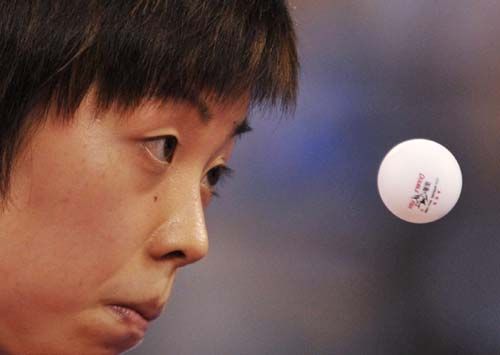
Zhang Yining is often remembered by a dramatic nickname: the Great Demon King.
It is a vivid label. She looked calm, rarely gave away cheap points, and often made opponents feel as if there was no obvious way through her. But if we only say "she was naturally unbeatable," we flatten the real value of her career.
The better question is: why did Zhang make table tennis look so controlled?
Her dominance was not built on one spectacular shot. It came from a system: balanced forehand and backhand quality, strong rally tolerance, low-risk decision-making, calm pressure-point execution, and the psychological hardness created by China's brutally competitive women's table tennis environment.
The Short Answer
| Dimension | Key fact | What it means |
|---|---|---|
| Olympic record | 2004 singles/doubles gold, 2008 singles/team gold | She delivered across two Olympic cycles |
| Grand Slam resume | Olympic, World Championships and World Cup singles titles | Her career was not built on one tournament |
| Double Grand Slam | Olympic singles in 2004/2008, Worlds in 2005/2009, World Cups in 2001/2002/2004/2005 | Her biggest wins were repeated |
| Long-term stability | Years near the top of the women's game | Dominance came from sustained output |
| Technical structure | Balanced wings, steady rallies, few errors | Opponents struggled to find a fixed weakness |
| Mental profile | Calm under pressure and willing to reduce risk | "Demon King" was really match-management skill |
| Competitive environment | China's internal table tennis depth | She was forged inside the toughest system first |
Olympedia records Zhang as a four-time Olympic gold medallist and notes that she won the World Cup four times and the Pro Tour Grand Finals six times. It also states that she was ranked No. 1 in the ITTF World Ranking from January 2003 through November 2009, dropping to second only for two months in 2008. Olympedia: Zhang Yining
Career Timeline
| Year | Event | Why it matters |
|---|---|---|
| 1981 | Born in Beijing | A home-grown product of China's table tennis system |
| Late 1990s | Emerged internationally | Moved from prospect to national-team contender |
| 2000 | Did not compete at the Sydney Olympics | Early disappointment became part of her development |
| 2001 | Won the Women's World Cup | Major-event winning ability began to form |
| 2004 | Won Olympic singles and doubles gold in Athens | Became an Olympic centerpiece |
| 2005 | Won the World Championships singles title | Completed a key Grand Slam piece |
| 2008 | Defended Olympic singles gold and won team gold in Beijing | Controlled the highest-pressure home Olympics |
| 2009 | Won another World Championships singles title | Extended her dominance late in her career |
| Around 2011 | Gradually stepped away from the international stage | Left after already securing historic status |
The Olympic World Library's Rio 2016 table tennis media guide describes Zhang as the only player to achieve two table tennis Grand Slam titles: Olympic singles gold in 2004 and 2008, World Championships singles gold in 2005 and 2009, and Women's World Cup titles in 2001, 2002, 2004 and 2005. Olympic World Library: Rio 2016 table tennis media guide
The Nickname Does Not Mean She Never Lost
Sports profiles often turn great athletes into natural invincibles.
That is not the most useful way to understand Zhang. She had setbacks. She grew in a Chinese women's team that included Wang Nan and other elite players. She also missed the Sydney 2000 Olympic team, a painful reminder that talent and potential do not automatically become selection.
For Chinese table tennis players, the hardest competition is often internal. Before facing the world, a player must first survive the deepest national-team pool in the sport.
That explains Zhang's later calmness. She was not relaxed because there was no pressure. She became calm because pressure had been normal for years.
Why Was She So Hard to Break Down?
Zhang's game did not always look explosive. That was part of the problem for opponents.
She did not dominate by producing one spectacular winner after another. She dominated by removing easy answers.
| Area | Zhang's strength | Pressure on opponents |
|---|---|---|
| Forehand | Stable quality and reliable rally strength | Opponents could not simply attack her forehand |
| Backhand | Strong defense and quick transitions | Pressure to the backhand did not produce easy errors |
| Rally play | Precise placement and rhythm control | Longer points often favored her consistency |
| Receive | Low-risk first response into controlled rallies | Opponents struggled to win cheap third-ball points |
| Pressure points | Conservative choices with enough quality | She rarely donated points under stress |
That is the real meaning of "Demon King." She did not need every point to look dramatic. She made opponents feel that every path was expensive.
Beijing 2008: The Best Window Into Her Dominance
The Beijing Olympics are the clearest case study.
Zhang was not only playing opponents. She was playing under home Olympic pressure, Chinese table tennis expectations, and the weight of being the defending champion.
She still defeated Wang Nan 4-1 in the women's singles final. The Beijing 2008 report confirms that Zhang defended her title at Peking University Gymnasium and won her fourth Olympic gold medal. Beijing 2008: Zhang Yining wins fourth table tennis gold
The symbolism was strong. Wang Nan had been one of the great figures Zhang had to chase. Beijing 2008 turned that long internal storyline into a visible handover from one Chinese women's table tennis era to another.
Why Wang Nan Matters to Zhang's Story
Wang Nan was not just an opponent in a final.
For the younger Zhang, Wang represented the standard: Olympic champion, world champion, and central figure of China's women's team. To pass that kind of player, Zhang needed more than talent. She needed stability, patience and better pressure management.
| Dimension | Wang Nan's role | What it forced Zhang to develop |
|---|---|---|
| Seniority | Established Olympic and world champion | Long-term pursuit rather than quick arrival |
| Big-match experience | Proven under maximum pressure | Better key-point handling |
| Team position | Core figure in China's women's team | Daily internal competition |
| Transition moment | 2008 Beijing Olympic final | Zhang moved fully from challenger to standard-bearer |
This is why "the shadow of Wang Nan" should not be treated as a weakness. It was part of Zhang's training ground.
Zhang Among China's Great Women's Champions
China's women's table tennis history is so strong that Zhang's place cannot be explained only by counting trophies.
| Player | Main historical image | What makes Zhang different |
|---|---|---|
| Deng Yaping | Early Olympic-era force | More associated with speed, ferocity and era creation |
| Wang Nan | Complete champion and senior leader | Zhang's career was partly shaped by chasing and then succeeding her |
| Zhang Yining | Calm, balanced, low-error dominance | She made "not giving chances" her signature |
| Li Xiaoxia, Ding Ning, Liu Shiwen and later stars | New-cycle elite players | Competed under changing balls, rules and training environments |
Zhang's uniqueness was not that she hit harder than everyone. It was that she made the match uncomfortable for everyone. If opponents attacked, she absorbed it. If they rallied, she outlasted them. If they waited for mistakes, they often waited too long.
What Can Be Learned Without Turning Her Into a Myth?
Zhang's story is inspiring, but it should not be reduced to "work hard and become unbeatable."
The useful lessons are more specific:
| Lesson | Meaning |
|---|---|
| Fundamentals first | Stability is built through thousands of repetitions, not sudden match-day calm |
| Balanced technique | Avoid giving opponents one obvious target |
| Risk control | Pressure points reward quality and margin, not reckless beauty |
| Review failure | Missing an Olympic team or losing to seniors can become useful feedback |
| Simplify the mind | Focus on the next shot, not the final result |
That is valuable for ordinary readers because it turns greatness from a slogan into a process. Dominance often means removing low-level errors from the system.
FAQ
Did Zhang Yining never lose?
No. Her greatness was not that she never lost. It was that she learned from setbacks and reduced the chance of losing during her peak.
Was she only a defensive player?
No. Her defense and rally stability were exceptional, but she was not passive. She controlled quality first, then attacked when the situation allowed.
Was "Great Demon King" just exaggeration?
The nickname is dramatic, but it has a real basis. Her low-error style, pressure-point calm and lack of obvious weaknesses made opponents feel trapped.
Is her legacy mainly Olympic?
The Olympics are the most visible part, but not the whole story. Her World Championships, World Cup titles and long No. 1 period complete the case.
Conclusion
Zhang Yining's legend should not stop at the nickname.
She was a champion shaped by pressure, selection, internal competition and relentless technical refinement. She had to chase. She had to miss out. She had to face senior champions. She had to carry home Olympic expectations.
Her greatest quality was not making table tennis look spectacular every second.
It was making the match feel like a problem with no easy solution.
Opponents could attack and take risks. They could rally and wait. They could search for mistakes. But too often, Zhang gave them nothing cheap.
That is what the "Great Demon King" really means.
Not natural invincibility, but a player who trained away so many weaknesses that opponents struggled to find an answer.