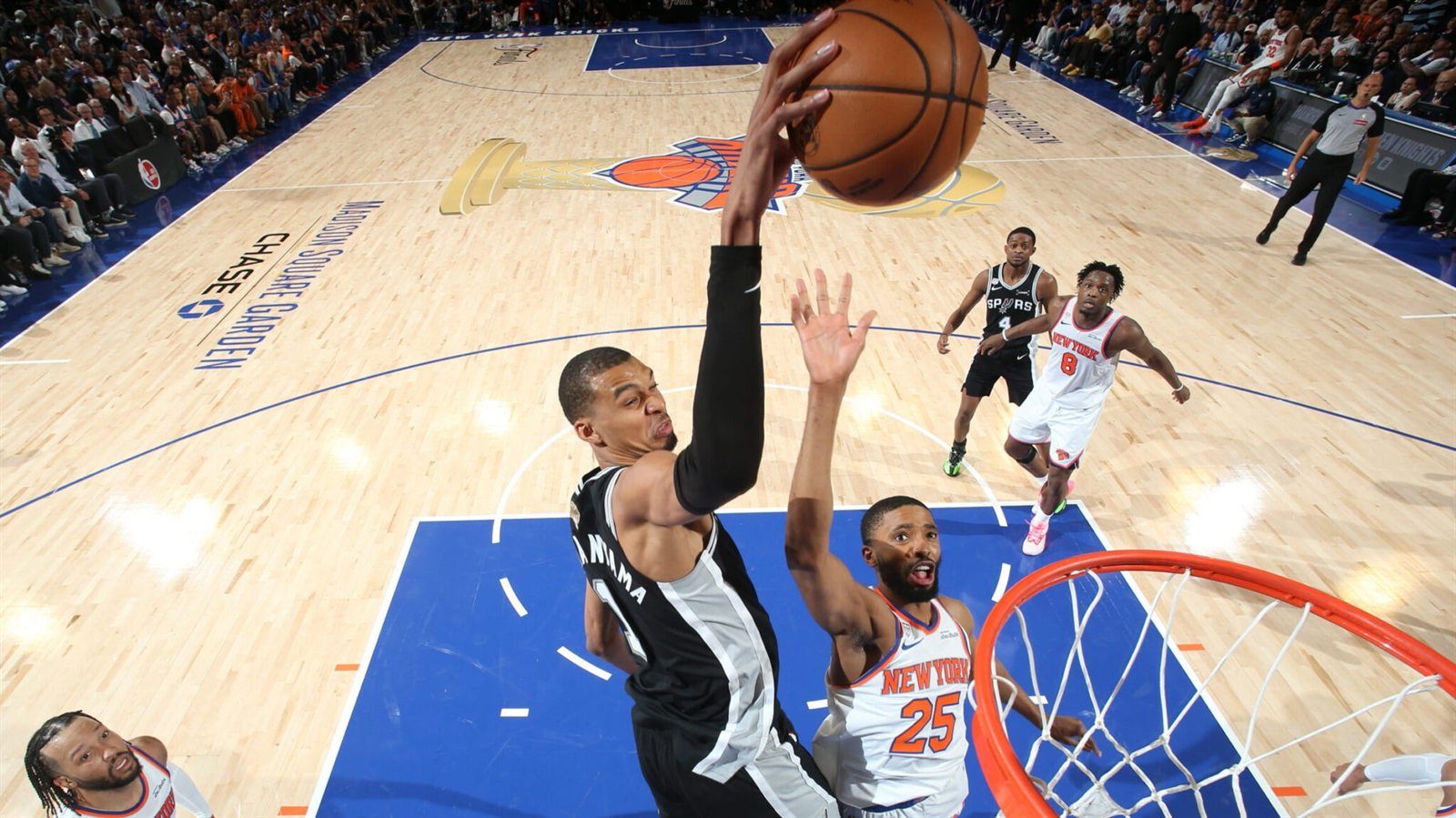
The San Antonio Spurs beat the New York Knicks 115-111 at Madison Square Garden, cutting the 2026 NBA Finals to 2-1.
That result is easy to flatten into one of two stories.
One story says Victor Wembanyama finally woke up. The other says the Knicks were hurt by the whistle. Both contain part of the truth, but neither is enough on its own.
The useful version is more precise: Wembanyama gave San Antonio the response it needed, Stephon Castle and De'Aaron Fox supplied late support, and the free-throw gap became a real talking point. But the Spurs also won the possession game in ways that cannot be reduced to officiating.
The Verified Game 3 Picture
| Category | What happened |
|---|---|
| Game | 2026 NBA Finals, Game 3 |
| Venue | Madison Square Garden, New York |
| Final score | Spurs 115, Knicks 111 |
| Series | Knicks lead 2-1 |
| Quarter scores | Spurs: 33, 24, 35, 23; Knicks: 22, 42, 27, 20 |
| Victor Wembanyama | 32 points, 8 rebounds, 6 assists, 3 blocks, 2 steals |
| Stephon Castle | 23 points, 5 rebounds, 5 assists |
| Knicks leaders | Jalen Brunson: 32 points; OG Anunoby: 28 points |
| Team edge | NBA.com listed San Antonio with 28 assists to New York's 18, a 21-7 edge in points off turnovers and only 8 turnovers |
| Free throws | Spurs 32 attempts, Knicks 22; second half reported as Spurs 24, Knicks 8 |
AP reported that the Spurs avoided a 3-0 hole, something no NBA Finals team has ever escaped.
That is why this was not just one road win. It changed the series from "New York can nearly end it" to "San Antonio has found a version of itself that can win."
What Wembanyama Actually Changed
Wembanyama's Game 2 problem was not simply a bad box score. His numbers were respectable, but the final possessions were costly. Game 3 was different because he entered the game earlier, connected better with teammates and made fewer high-pressure mistakes.
| Area | Game 2 problem | Game 3 response |
|---|---|---|
| Start | Too slow to impose himself | Immediate first-quarter presence |
| Offensive role | Late possessions carried too much weight | Earlier touches near the rim and in the middle of the floor |
| Playmaking | Gravity did not always become team offense | 6 assists helped San Antonio turn attention into advantage |
| Fourth quarter | Late turnover and missed winner defined the finish | 10 fourth-quarter points helped stabilize the Spurs |
| Defense | Talent was visible but not always controlling | 3 blocks and 2 steals changed New York's finishing choices |
The key is not just that Wembanyama scored 32. It is that his scoring made the rest of San Antonio's structure easier.
When he catches deeper, the Knicks have to shrink the floor. When he passes out of pressure, cutters and shooters get cleaner windows. When he protects the rim, New York's drives carry extra hesitation.
That is the difference between a great stat line and a game-shaping performance.
Castle and Fox Kept the Spurs From Becoming Too Wemby-Dependent
The source video correctly highlights Castle's aggression.
Castle finished with 23 points, 5 rebounds and 5 assists. More importantly, he gave San Antonio a second player who could attack the Knicks' smaller matchups, get downhill and finish late possessions without waiting for Wembanyama to solve everything.
Fox mattered in a different way. His speed and late shot-making gave San Antonio another pressure release. AP noted that Castle and Fox both hit important shots late as the Spurs kept the series alive.
That is what made the Spurs look more complete than they did in the first two games.
An elite team cannot ask one star to carry every emotional and tactical burden. Game 3 worked because Wembanyama bent the defense and his teammates punished the bend.
The Knicks Lost, But Not Because They Collapsed
New York still had strong arguments in this game.
Brunson scored 32 points and remained the Knicks' best half-court organizer. Anunoby scored 28 on highly efficient shooting, giving New York far more than a simple 3-and-D contribution. The Knicks also exploded for 42 points in the second quarter, flipping the game after a rough start.
So yes, "honorable loss" is a fair emotional description.
But it should not hide the basketball reasons New York lost.
NBA.com's numbers are revealing: San Antonio had 28 assists to New York's 18, won points off turnovers 21-7 and committed only eight turnovers. In a four-point Finals game, those are not footnotes. They are the game.
The Knicks can complain about the whistle and still need to address their own possession quality.
How To Handle the Officiating Debate
The free-throw issue is real.
Multiple postgame reports noted that San Antonio attempted 32 free throws to New York's 22. Knicks coach Mike Brown specifically objected to the second-half gap, when the Spurs were reported with 24 attempts to the Knicks' eight.
That is legitimate context. It belongs in any serious Game 3 analysis.
But there is a line between context and conclusion.
| Fair to say | Too strong without evidence |
|---|---|
| The free-throw disparity was significant | The league wanted San Antonio to win |
| Mike Brown publicly criticized the whistle | The referees intentionally extended the series |
| New York felt the second-half whistle changed the game | The Knicks would definitely be up 3-0 with fair officiating |
| Game 4 will be watched closely for consistency | San Antonio's win has no basketball value |
The better conclusion is this: the whistle helped shape the debate, but San Antonio's win still came from Wembanyama's response, Castle's pressure, Fox's late plays, clean passing, low turnovers and better conversion of New York mistakes.
What This Means for Game 4
| Question | Why it matters |
|---|---|
| Can Wembanyama start fast again? | One response game is impressive; two in a row changes the series |
| Can Castle keep pressuring New York's smaller defenders? | He reduces the burden on Wembanyama |
| Can Karl-Anthony Towns regain his series influence? | New York needs him to pull Wembanyama away from his best defensive zones |
| Can Brunson lower the cost of San Antonio pressure? | The Spurs turned New York mistakes into a major scoring source |
| Does the whistle tighten or even out? | Brown's postgame comments will put Game 4 officiating under a microscope |
| Can Anunoby stay this efficient? | His scoring gives New York a second route when Brunson is crowded |
The series is still in New York's hands. A 2-1 lead is real, and the Knicks have already proved they can win in San Antonio.
But Game 3 proved something San Antonio needed badly: the Spurs have a winning formula if Wembanyama starts early, Castle attacks, Fox hits late and the team protects the ball.
The Bottom Line
Game 3 should not be reduced to a single narrative.
Wembanyama was excellent. Castle was fearless. Fox helped close. Brunson and Anunoby gave the Knicks enough offense to win. The free-throw disparity was real enough to become part of the story.
But the most important lesson is structural: San Antonio finally turned Wembanyama's talent into team rhythm, while New York paid for turnovers, late defensive stress and a thinner offensive mix than it had in the first two games.
That is a better explanation than simply saying the Spurs were rescued or the Knicks were robbed.
FAQ
What was the final score of Spurs vs Knicks Game 3?
The Spurs beat the Knicks 115-111 in Game 3 of the 2026 NBA Finals. New York still leads the series 2-1.
What was Victor Wembanyama's Game 3 stat line?
Wembanyama had 32 points, 8 rebounds, 6 assists, 3 blocks and 2 steals.
Who led the Knicks?
Jalen Brunson scored 32 points and OG Anunoby added 28. They were the main reasons New York stayed close despite the loss.
Was there an officiating controversy?
Yes. The Spurs attempted 32 free throws to the Knicks' 22, and the second-half gap was reported as 24 to 8. Knicks coach Mike Brown publicly criticized the disparity. That is important context, but it does not prove the game was decided only by officiating.
What is the biggest Game 4 adjustment?
For San Antonio, the challenge is repeating Wembanyama's early involvement and Castle's downhill pressure. For New York, the key is reducing turnovers and getting Karl-Anthony Towns back into a more influential offensive role.