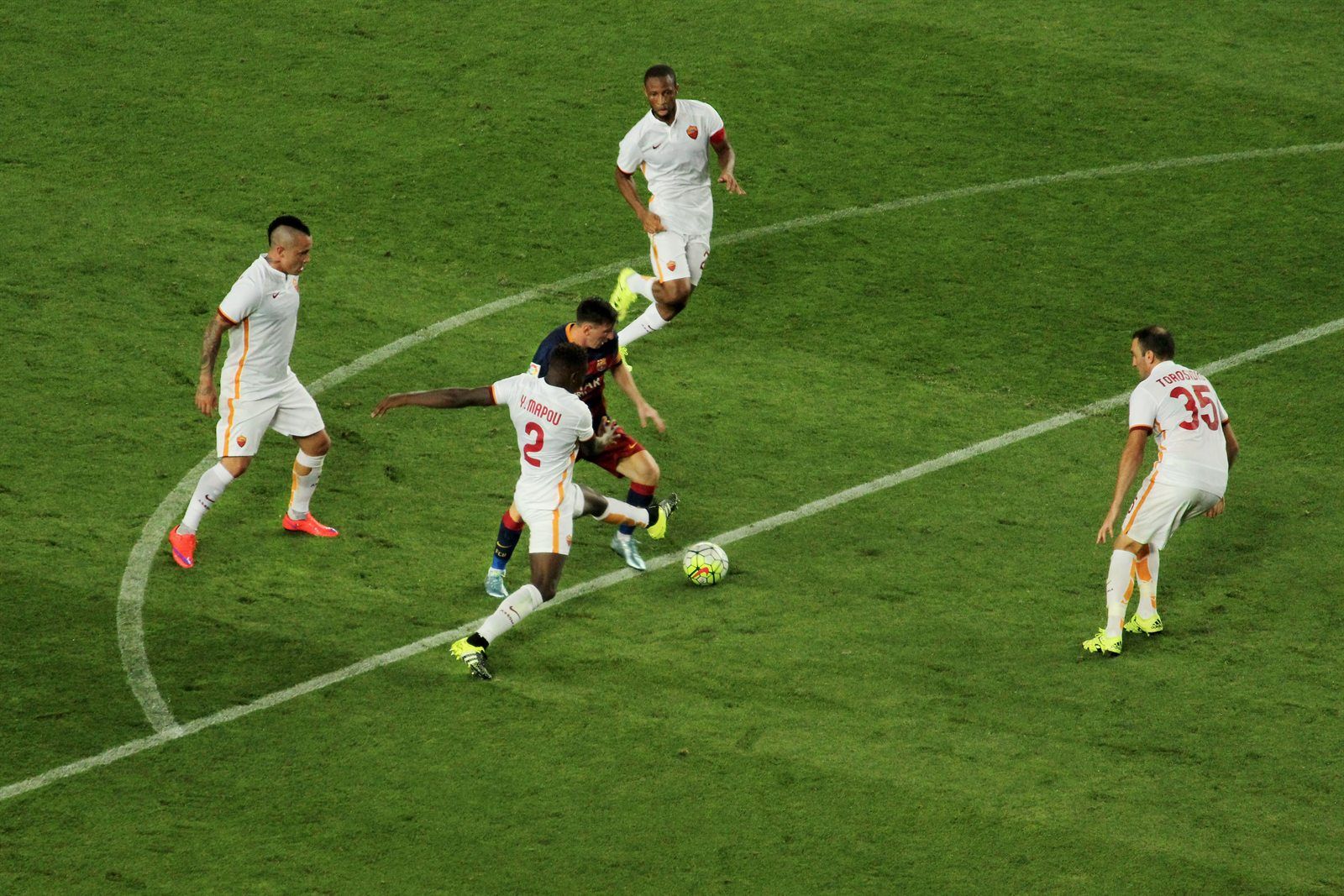
Messi's greatness is not only measured by goals, trophies, or Ballon d'Or awards. What makes his career so unusual is his ability to keep changing roles as football itself changed around him. From an explosive right-sided attacker to a false nine, then to a free forward and playmaking organizer, his career reads like a map of how modern attacking football evolved.
1. Beyond Childhood Talent: Messi's Earliest Gift Was Speed of Processing
When people talk about Messi, it is natural to begin with Rosario, his grandmother, Newell's Old Boys, and his growth hormone deficiency. Those details matter, but if the story stops at inspiration, it misses the football trait that made him rare.
Messi's early standout quality was not simply that he could dribble. It was how quickly he processed the game. In tight spaces, he could scan, touch, shift direction, and accelerate with almost no wasted movement. That meant defenders could often read that he wanted to cut inside, yet still fail to time the tackle.
That quality followed him through every stage of his career. As a teenager, it appeared as one-on-one dominance from the right wing. Later, it became quick turns in central areas, diagonal passes, and final balls around the edge of the box. Messi's technique was never tied to one fixed position. It was a decision-making system that could move from one tactical role to another.
2. La Masia Gave Him the Right Football Language
Joining Barcelona did more than solve questions around treatment and development. It placed Messi inside a football culture built on short passing, support angles, space occupation, and control of rhythm.
La Masia did not turn Messi into a standard academy product. Its real value was that it allowed his individual brilliance to work inside a collective structure. Many gifted young players can dominate youth football through speed and dribbling, only to struggle later because their actions are strong but their positional understanding is limited. Messi was different. At Barcelona, he learned early how to find opportunities between teammates' positions, passing lanes, and defensive movement.
That is why his later understanding with Xavi, Andres Iniesta, Sergio Busquets, and others looked so natural. Messi was not an outside weapon attached to the system. He gradually became the system's sharpest variable.
3. The Right-Wing Years: Changing the Angle of Attack
In his early first-team years, Messi usually operated from the right. On paper, it looked like a traditional wide role. In practice, it gave him two natural advantages: the shooting angle for his left-footed cut inside, and a wide starting position from which he could read the whole pitch.
Many wingers of that period were expected to beat a full-back and cross. Messi was closer to a central attacker who started from the flank. His first move was not always to reach the byline. Often, it was to pull the defender into his rhythm, then cut inside and compress the entire back line toward the edge of the penalty area.
His first senior goal for Barcelona against Albacete in 2005 is often remembered as a symbolic handover from Ronaldinho. The more interesting detail is that the goal already showed a pattern Messi would repeat for years: receive from the right, make a sudden run, and finish with very few touches. Ronaldinho protected him in the dressing room and on the pitch, while Barcelona gave him a technical platform high enough to match his talent.
At this stage, Messi was not yet the team's full attacking organizer, but his threat was already changing how opponents defended. Full-backs could not step out carelessly. Centre-backs had to prepare to cover. His cut inside was not one action; it was a multiple-choice problem involving a shot, a through ball, or another dribble.
4. The False Nine: Guardiola Put Messi in the Hardest Zone to Defend
When Pep Guardiola took over Barcelona in 2008, Messi's role changed decisively. He was no longer only a right-sided threat. He began moving more often into central areas, becoming the core of Barcelona's false-nine structure.
The difficulty of defending a false nine is not the label. It is the choice it forces on defenders. If a centre-back follows, space opens behind the line. If he stays, Messi can receive between the lines, turn, and attack the midfield and defence directly. That dilemma became one of the most dangerous mechanisms of Guardiola's Barcelona.
In the 2009 Champions League final, Barcelona beat Manchester United 2-0, and Messi scored an unusual header. In that move, Xavi crossed from the right and Messi arrived behind the defensive line, finishing in a way that did not rely on height. The match mattered not only because Barcelona won the trophy, but because it showed that their possession was not possession for its own sake. The aim was to push the opponent into a position where they could not protect the wings, the centre, and the space behind all at once.
Messi's value expanded dramatically in this role. He could finish like a striker, connect play like an attacking midfielder, and create one-on-one advantages like a winger. For a possession-based team, that meant three positional functions were compressed into one player.
5. The 91-Goal Year Was Not an Isolated Miracle
In 2012, Messi scored 91 goals in a calendar year. That number is often discussed as a pure individual miracle. It was certainly an extreme display of individual quality, but focusing only on the total can hide the tactical conditions behind it.
Barcelona gave Messi three stable advantages at that time: a midfield capable of delivering the ball into dangerous areas again and again, clear rotation between wide and central zones, and a collective pressing game that allowed attacking sequences to restart quickly. Messi turned those conditions into extraordinary efficiency.
In other words, the 91-goal year was not simply the result of an entire team feeding one player. Nor was it a miracle created by Messi outside the system. A better explanation is this: Barcelona built an attacking structure at a historic level, and Messi had the finishing, dribbling, and judgment to push that structure to its absolute ceiling.
6. The MSN Era: From Main Finisher to Attacking Distributor
After Neymar and Luis Suarez arrived, Messi's role changed again. Barcelona in the MSN era relied less exclusively on long spells of positional possession and added more vertical attacks and fast transitions.
This period shows Messi's adaptability clearly. Normally, when two elite forwards join a team, the main star's touches and numbers can be diluted. Messi did not insist that every attack had to end through him. Instead, he moved part of his value into distribution and control of attacking choices.
Suarez provided penalty-box movement and central occupation. Neymar brought left-sided dribbling and weak-side danger. Messi often operated between the right half-space and central areas, choosing whether to pass, carry, or shoot. Barcelona's 2014-15 treble was not only about three brilliant forwards. It worked because their functions fit together.
The Champions League semi-final against Bayern Munich was one of the clearest examples. Messi first broke the match open with a low finish from the edge of the area. Then he used quick changes of direction to unbalance Jerome Boateng before lifting the ball over Manuel Neuer. Those two actions showed different parts of the same player: speed of decision near the box, and one-on-one finishing under pressure. They also explain why even a compact Bayern defence could not fully contain him.
By this stage, Messi was no longer just a goal machine. He was increasingly responsible for deciding the direction of attacks: when to speed up, when to switch the ball, when to give Neymar the isolation, and when to cut inside himself.
In the final against Juventus, Messi did not need to shoot in every sequence to shape the game. His movement and presence kept drawing defensive attention, which opened room for Neymar and Suarez. That detail matters. MSN was not just three forwards taking turns to attack. It worked because Messi could switch quickly between finisher and distributor.
7. After Barcelona: Paris Exposed the Difference Between Stars and Structure
Leaving Barcelona in 2021 was the biggest structural change of Messi's career. For more than a decade, the teammates, passing habits, and attacking triggers around him had been unusually stable. At Paris Saint-Germain, he had to adapt to a new league rhythm, new movement patterns, and a different balance of tactical responsibility.
Messi did not reproduce his Barcelona dominance at PSG, and that was not surprising. Football does not automatically become a system just because elite attackers are placed together. Messi, Neymar, and Kylian Mbappe all needed touches and space. Whether the midfield and defence could support that freedom determined the team's ceiling.
Still, the Paris period was not meaningless. Messi became more visibly playmaking-oriented, reducing long dribbling sequences and increasing deeper receptions, diagonal passes, and final balls around the box. That adjustment also prepared him for his final push with Argentina.
8. Argentina's Solution Was Not Asking Messi to Solve Everything Alone
Messi's international career was long defined by the absence of a World Cup title, but that was always too simple. The real question was not whether Messi was good enough. It was whether Argentina could build a structure that allowed his qualities to matter in the right zones.
In 2014, Argentina came close, but the team depended heavily on defensive stability and Messi's moments in the final third. Under Lionel Scaloni, the plan became clearer. Argentina no longer asked Messi to cover every problem. Rodrigo De Paul, Enzo Fernandez, Alexis Mac Allister, and others provided running, protection, duels, and second-phase progression, allowing Messi to focus his energy where it mattered most.
The Messi of the 2022 World Cup was not the most physically explosive version of Messi, but he may have been the best-used version for Argentina. He did not need to dribble from the halfway line every time. He did not need to force speed into every possession. More often, he controlled key zones: a pause, a through ball, a penalty, or a small escape near the box could change the match.
The final against France was the clearest example. Messi handled finishing duties through a penalty and a close-range goal, but he also helped Argentina slow the game down through short passes and pauses in midfield. By extra time and the penalty shootout, the match was not only about technique. It was about handling pressure, and Messi continued to make stable choices inside that pressure.
That was one of the main reasons Argentina finally won. They were not simply waiting for Messi to win the World Cup alone. They had finally found a way to maximize Messi while giving the rest of the team clear responsibilities.
9. Why Messi Could Cross Three Eras
What makes Messi exceptional is not only the trophies, Ballon d'Or awards, or scoring records. It is that his ability was never locked inside one tactical era.
When traditional wide attackers still had more room, he destroyed defences by cutting in from the right. When possession football reached its peak, he became a false nine and central finishing hub. When high pressing and fast transitions became more common, he moved deeper and continued to influence matches through passing and rhythm.
Many players depend heavily on pace, and when that pace fades, their value falls with it. Messi is different. His underlying advantages are touch quality, speed of perception, and choice. Those qualities change form with age, but they do not disappear as suddenly as pure speed.
So the better question is not only "How many goals did Messi score?" It is also: what tactical problems did he solve for different teams? How did he change the way opponents defended? Why could he evolve from a wide dribbler into the player who explained an entire team's attack?
From that angle, Messi's career is not just a linear story of greatness. It is a history of modern attacking football told through one player's changing role.
References
- FC Barcelona: Leo Messi, FC Barcelona's historic record breaker
- FC Barcelona: Leo Messi becomes the most decorated player in history
- FIFA: Messi makes Golden Ball history
- FIFA: Lionel Messi, Inter Miami profile
- UEFA: Messi leads Barca to Rome glory
- Guinness World Records: Most football goals scored in a calendar year