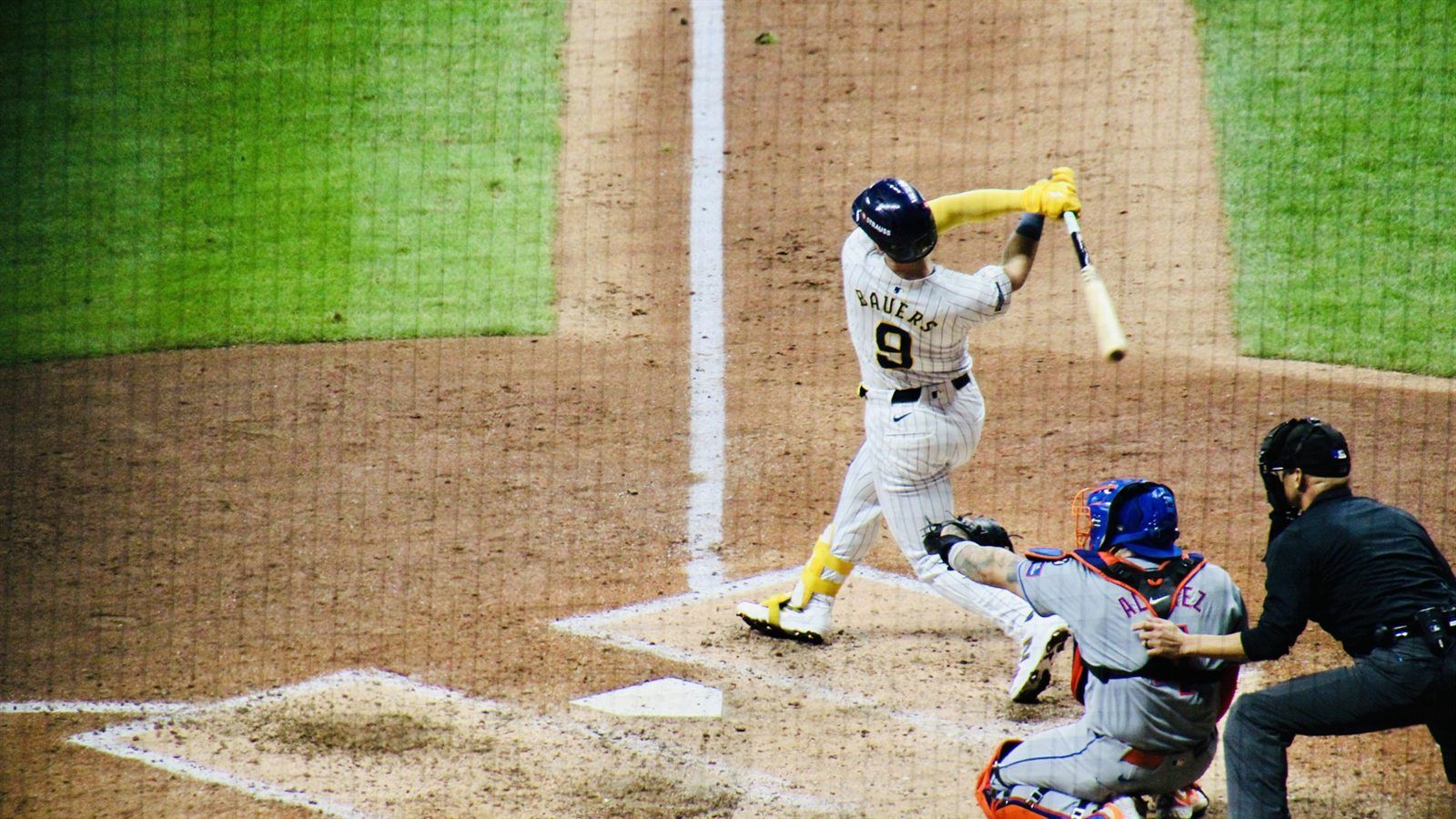
Jake Bauers has been easy to overlook for most of his major-league career.
That is partly because his path has never been clean. He was a seventh-round pick by the Padres, became a notable Rays prospect, moved through several organizations, and spent years looking like a useful but inconsistent left-handed bat. For a player like that, a hot month can easily be dismissed as noise.
But the MLB Central segment on Bauers makes a stronger argument: this version of Bauers is not only hitting. He is controlling the strike zone, punishing mistakes, handling non-fastballs, doing damage against elevated fastballs and benefiting from a swing setup that gives him a clearer plan.
That combination is more interesting than a random batting-average spike.
As of June 2, 2026, MLB's player page listed Bauers at .287/.358/.497 with 10 home runs and 36 RBI for Milwaukee. The surface numbers are good. The deeper question is whether the underlying skills explain them.
The answer appears to be yes.
The Short Version
| Question | Answer |
|---|---|
| Why is Bauers getting attention? | His May-to-June production has been supported by walks, hard contact and better pitch selection. |
| What makes the breakout believable? | He is not only pulling mistakes; he is controlling the zone and handling multiple pitch types. |
| What changed mechanically? | MLB Central highlighted a narrower stance, an opened front foot and better balance into the back hip. |
| Why does Milwaukee matter? | The Brewers seem to have found a role that lets him add value without needing to be the lineup's star. |
| What is the risk? | Hot stretches cool off, and Bauers still has a long track record of uneven production. |
From Prospect to Role Player to Real Contributor
Bauers' career has included a lot of stops.
MLB's player page lists him as a seventh-round pick by San Diego in 2013. He later moved to Tampa Bay in the Wil Myers trade, debuted with the Rays in 2018, and eventually played for Cleveland, Seattle, Cincinnati, the Yankees and Milwaukee.
That kind of path often creates a label: interesting tools, no permanent home.
Milwaukee may have changed the second part.
The Brewers acquired Bauers before the 2024 season and later brought him back on a minor-league deal before 2025. By 2026, he had become a useful part of a deeper lineup. That matters because hitters like Bauers often need the right environment: enough playing time to stay sharp, enough role clarity to avoid pressing, and enough lineup protection to let their plate discipline matter.
The Four-Walk Game Explains the New Bauers
The segment opens with a simple point: Bauers walked four times in a game against San Francisco, one shy of the Brewers' club record.
That matters because it shows value without a hit.
MLB posted the ABS challenge walk from that June 1 game, and Bauers' player log shows the four-walk line. The key takeaway is not that four walks are glamorous. It is that a hitter who refuses to chase can change an inning even when he does not swing.
For a supporting lineup piece, that is a big deal.
If Bauers is only valuable when he homers, his value is fragile. If he can also win plate appearances by taking close pitches, forcing pitchers into the zone and reaching base for Milwaukee's bigger bats, he becomes much harder to bench.
Plate Discipline Plus Hard Contact Is the Real Signal
The most persuasive part of the MLB Central discussion is the pairing of two skills:
- Bauers is not chasing as much.
- When he gets his pitch, he hits it hard.
That combination is more valuable than either skill alone.
| Skill | Why it matters |
|---|---|
| Low chase rate | Forces pitchers to throw strikes and creates walk value |
| Hard-hit ability | Turns mistakes into extra-base damage |
| Non-fastball damage | Prevents pitchers from solving him with sliders, sweepers and changeups |
| Elevated fastball success | Reduces a common attack plan against left-handed power hitters |
| Pull-side power with opposite-field flexibility | Lets him hunt damage without becoming one-dimensional |
Baseball Savant's 2026 page supports the general idea that Bauers is doing real damage. It shows strong contact quality and useful pitch-type production, including positive results against several breaking and cutting pitches. A May 20 Savant game preview also listed a 54.7% hard-hit rate, a strong indicator that his quality of contact was not soft-contact luck.
Why Handling Non-Fastballs Matters
Many hitters can crush a predictable fastball.
The league adjusts quickly. Once a hitter starts producing, pitchers test whether he can handle sliders, sweepers, cutters and elevated heat.
The segment notes that Bauers has been dangerous against non-fastballs since early May. That matters because it attacks one of the usual ways pitchers neutralize left-handed power: expand away with breaking stuff, then climb the ladder with fastballs.
If Bauers can take the breaking balls that start off the plate, shoot some of them the other way and still punish elevated fastballs, his offensive profile becomes much less exploitable.
That is the difference between a hot streak and a changed approach.
The Swing Change: Narrower, Open, More Balanced
The mechanical portion of the segment is especially useful.
MLB Central points out that Bauers has become more narrow in his stance, opened the front foot and stayed more connected to his back hip. The analysts also note that his shoulders cannot simply follow the front hip open. If they do, the swing pulls off the ball and loses plane.
In plain English:
- the open front foot may help him see and access pitches;
- the narrower stance can simplify his move;
- staying into the back hip gives him time and balance;
- keeping the shoulders level helps him cover the zone instead of yanking off pitches.
This fits the statistical story.
A hitter who is better balanced can let pitches travel. A hitter who lets pitches travel can recognize spin longer. A hitter who recognizes spin longer can chase less and hit non-fastballs better.
The swing and the stat line are telling the same story.
Why Milwaukee Is the Right Fit
Not every breakout is only about the player.
Role matters.
Bauers does not have to be Milwaukee's franchise hitter. He has to be a dangerous supporting bat who lengthens the lineup, punishes right-handed pitching, takes walks and forces opponents to work through the bottom or middle of the order.
That is exactly the kind of player who can swing a postseason series.
When a team has stars at the top and a supporting cast that controls the zone, the lineup stops giving pitchers easy innings. Bauers' rise helps Milwaukee because it makes the Brewers less dependent on a small group of obvious bats.
What Could Still Go Wrong?
There is still reason for caution.
Bauers' career before this stretch was uneven. Pitchers will adjust. Hot strike-zone numbers can regress. A hitter who becomes known for taking borderline pitches may start seeing more early-count strikes. If opponents find a consistent way to beat him inside or above the zone, he will need another counter.
That is why the right conclusion is not "Bauers is suddenly a star."
The better conclusion is: Bauers has become a much more believable above-average contributor because the skills supporting the production are real.
The Bigger Lesson
Baseball breakouts are easiest to believe when multiple signals line up.
With Bauers, they do:
- the surface production is there;
- the walks are there;
- the contact quality is there;
- the non-fastball damage is there;
- the swing explanation is there;
- the team fit is there.
That does not guarantee a full-season star turn. But it does explain why MLB Central spent a segment on him and why Milwaukee should treat him as more than a bench bat riding a heater.
Jake Bauers may still be underrated.
But he is no longer hard to explain.
FAQ
Why is Jake Bauers considered underrated?
Because his 2026 production has come with less national attention than bigger-name hitters, but his plate discipline, hard contact and pitch-type success suggest real skill improvement.
What team does Jake Bauers play for?
He plays for the Milwaukee Brewers.
Was Jake Bauers a high draft pick?
No. MLB lists him as a seventh-round pick by the San Diego Padres in the 2013 Draft.
What does wRC+ mean?
wRC+ is Weighted Runs Created Plus. It estimates overall offensive value while adjusting for league and park context. A 100 wRC+ is league average; higher is better.
Why are chase rate and hard-hit rate important together?
Chase rate shows whether a hitter avoids bad pitches. Hard-hit rate shows whether he does damage when he swings. Together, they suggest a hitter is both selective and dangerous.
Is Bauers' breakout guaranteed to last?
No. Pitchers will adjust, and his previous career was inconsistent. But the combination of better zone control, hard contact and swing stability makes the breakout more credible than a simple hot streak.