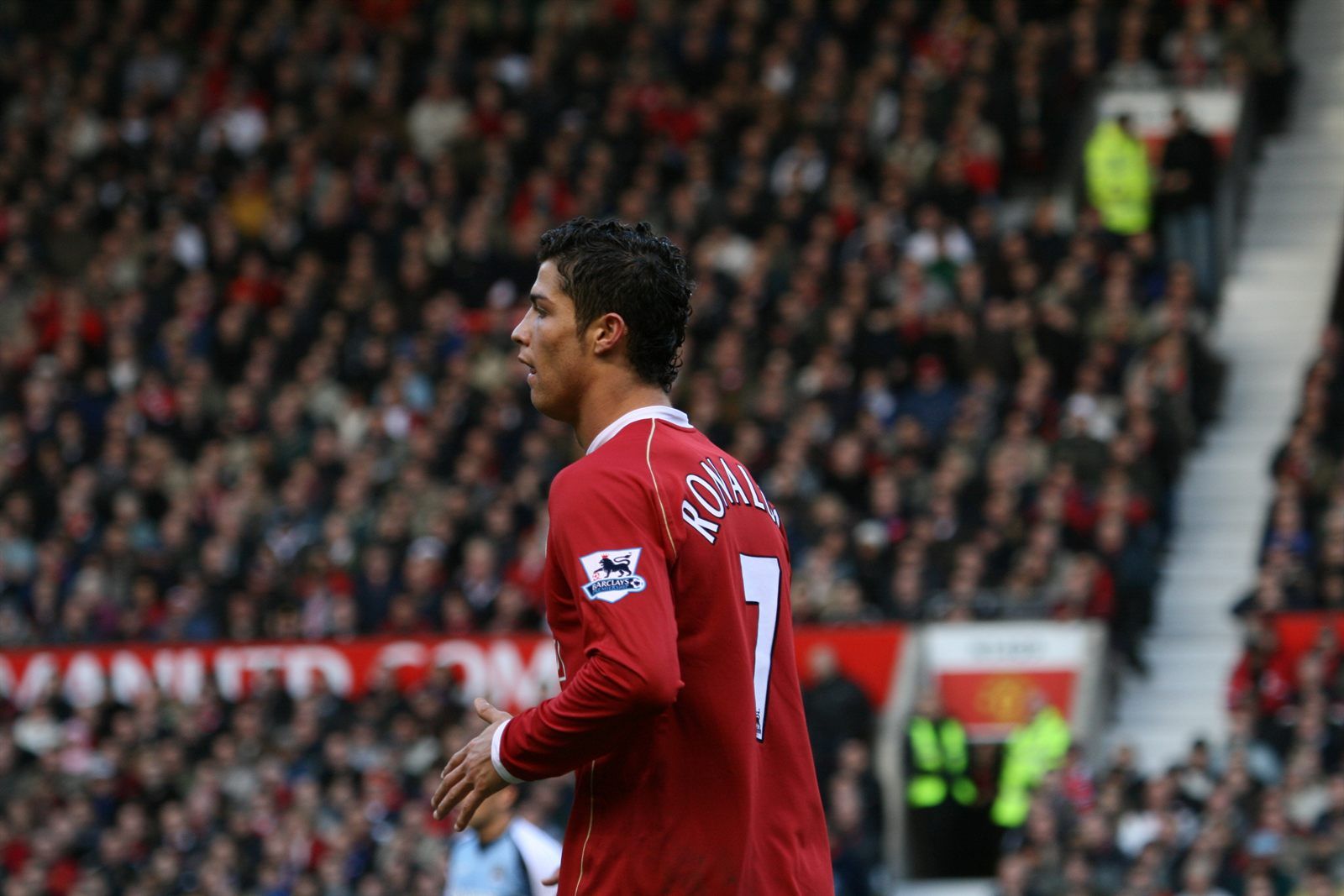
The question "which Cristiano Ronaldo was the strongest?" usually produces two answers.
One is Real Madrid Ronaldo: the goal machine, the Champions League killer, the penalty-box finisher with absurd numbers.
The other is late-Manchester-United Ronaldo: the winger-forward hybrid who could sprint the length of the pitch, dribble, head the ball, hit free-kicks, launch long-range shots and finish counterattacks at full speed.
This article is not trying to settle the debate with one universal answer.
The better question is: if we judge by athletic explosion, pitch coverage, long-range threat, wing play and counterattacking force, why does the 2007-09 version of Ronaldo feel so unforgettable?
The 2009 Champions League semi-final second leg, Arsenal 1-3 Manchester United, is the perfect case study.
The Short Answer
| Area | Late-United Ronaldo | Why it mattered |
|---|---|---|
| Engine and sprinting | Could run from deep areas to the box | Made United's counterattack terrifying |
| Long-range threat | Free-kicks and open-play rockets | Defenders had to guard far outside the box |
| Wing ability | Still carried strong one-on-one threat | Could progress play as well as finish it |
| Central scoring | Heading and off-ball runs had matured | Already moving toward striker-level production |
| Tactical fit | Worked with Rooney, Tevez, Park and a high-intensity United side | United could attack space brutally |
| Visual impact | Big movements, speed, tricks and violent shooting | More spectacular than the later pure finisher version |
The appeal of this Ronaldo is not that he scored more than the Real Madrid version. It is that he combined winger electricity, striker finishing and track-athlete physicality.
The 2009 Arsenal Match
Manchester United entered the second leg of the 2008/09 Champions League semi-final with a 1-0 lead over Arsenal.
Arsenal had to attack. United were built to punish the space behind them.
UEFA's match report confirms that United won 3-1 away and advanced to the final 4-1 on aggregate. Arsenal's hopes effectively collapsed inside the first 11 minutes: Ji-Sung Park scored after Kieran Gibbs slipped, and Ronaldo then beat Manuel Almunia with a free-kick. UEFA: Ronaldo leads ruthless United to Rome
| Time | Event | Tactical meaning |
|---|---|---|
| 8th minute | Gibbs slipped, Park scored | Arsenal had to chase even harder |
| 11th minute | Ronaldo scored a long free-kick | United damaged Arsenal tactically and mentally |
| Second half | United countered at speed, Ronaldo scored again | Ronaldo's ideal environment appeared |
| Full time | United won 3-1, 4-1 aggregate | Defending champions returned to the final |
This was not just a highlight game. It showed late-United Ronaldo's full package: long-range shooting, transition speed, finishing, big-game confidence and physical threat.
Why the Free-Kick Became Iconic
Many players take free-kicks. Many can shoot from distance.
Ronaldo's threat in that period felt different because the range itself became part of the danger. From that distance, the normal expectation might be a cross or a floated delivery. Ronaldo shot.
| Effect | Meaning |
|---|---|
| Expanded defensive radius | Fouls 35 meters out still felt dangerous |
| Changed goalkeeper expectations | The keeper could not assume a cross |
| Added psychological pressure | One foul could become a direct shot |
| Strengthened individual aura | Fans remembered that he dared and could score from there |
Calling it a "long-range missile" is dramatic, but it captures the feeling. Ronaldo turned low-percentage actions into real threats.
Why United's System Amplified Him
Sir Alex Ferguson's late-2000s United did not simply give Ronaldo the ball and wait.
The structure suited him.
| Teammate / role | How it helped Ronaldo |
|---|---|
| Wayne Rooney | Could drop, pass, press and run to open space |
| Carlos Tevez | Added pressing and chaos |
| Ji-Sung Park | Covered huge ground and attacked spaces |
| Michael Carrick / Paul Scholes | Provided passing and switches |
| Rio Ferdinand / Nemanja Vidic | Gave United a defensive base for fast transitions |
In this system, Ronaldo was not a traditional winger and not yet the later penalty-box specialist. He was a high-freedom counterattacking endpoint: starting wide, arriving central, or ending the sequence from distance.
That is why this version is so magnetic. He worked across several attacking zones at once.
The 2007/08 Foundation
The Arsenal match came near the end of Ronaldo's first United spell, but his world-best status was established in 2007/08.
UEFA reported that Ronaldo won the 2008 Ballon d'Or after scoring 42 goals in all competitions, helping Manchester United win the Premier League and Champions League. His 31 Premier League goals won the European Golden Shoe, and he also finished as Champions League top scorer with seven goals. UEFA: Ballon d'Or crowns Ronaldo's golden year
| 2007/08 achievement | Meaning |
|---|---|
| 42 goals | Forward-level production from a winger role |
| Premier League title | Domestic dominance |
| Champions League title | European validation |
| European Golden Shoe | Reward for 31 league goals |
| 2008 Ballon d'Or | Official confirmation as the world's best |
UEFA also confirmed that Ronaldo won the ESM Golden Shoe after his 31-goal Premier League season. UEFA: Ronaldo scoops ESM Golden Shoe
United Ronaldo vs Real Madrid Ronaldo
If the standard is scoring volume, Real Madrid Ronaldo is the stronger answer.
But the player models are different.
| Area | Late-United Ronaldo | Real Madrid Ronaldo |
|---|---|---|
| Role | Winger, transition runner, long-shot threat, finisher | Penalty-box killer and Champions League scorer |
| Visual impact | Sprinting, tricks, long shots, big movements | Off-ball runs, headers, weak-side finishing |
| Physical use | More explosive and all-action | More efficient and selective |
| Main zones | Wide areas, half-spaces, outside the box, central runs | Box, weak side, final action zones |
| Tactical value | Progression plus finishing | Historic finishing efficiency |
So before asking which version was better, we need to ask which criteria matter.
For goal efficiency and Champions League knockout production, Real Madrid Ronaldo is ahead.
For athletic shock, wing power, long-range threat and visual chaos, late-United Ronaldo may be the most thrilling version.
What Arsenal Exposed
Arsenal were not a bad technical team.
They had passing quality, midfield combinations and Wenger's familiar attacking ideas. But in this match, the problem was structural. Once Arsenal had to chase, space opened behind them. United had exactly the players to attack that space.
| Arsenal problem | United answer |
|---|---|
| Needed to attack because of aggregate deficit | Waited for transition space |
| Full-backs and midfield pushed high | Ronaldo and Rooney attacked behind |
| Turnovers left long recovery distances | United turned defense into attack quickly |
| Early goals damaged the plan | Match rhythm moved toward United |
That is why Ronaldo's performance felt so overwhelming. It was not only individual brilliance. It hit the weak point of the opponent's structure.
Why Rome 2009 Adds a Boundary
United beat Arsenal and reached the final in Rome, where they faced Barcelona.
UEFA's 2008/09 season review framed the final as a Messi-Ronaldo showdown, but Barcelona won and completed the treble. UEFA: Messi outshines Ronaldo in Rome
That matters.
Late-United Ronaldo was spectacular, but he was not unbeatable. Against peak Barcelona's control, pressing and structure, United could not recreate the same counterattacking dominance they found against Arsenal.
Individual form must still be judged inside team context and opponent quality.
How to Watch This Version of Ronaldo
If you rewatch late-United Ronaldo, do not only wait for goals.
Watch these details:
| Detail | What to observe |
|---|---|
| Starting position | Does he begin wide, inside, or deeper? |
| First touch | Does it take the ball forward immediately? |
| Shooting range | How far from goal does he consider a shot possible? |
| Off-ball sprint | Does he arrive at the back post or central lane? |
| Repeated running | Can he still shoot cleanly after long sprints? |
Seen this way, he was not just a trick-heavy winger. He was already converting winger threat into striker-level output.
FAQ
Was Manchester United Ronaldo better than Real Madrid Ronaldo?
Not automatically. Madrid Ronaldo was the superior scorer and Champions League knockout finisher. Late-United Ronaldo was more explosive, more winger-like and more visually overwhelming.
Why is the 2009 Arsenal match so famous?
Because it concentrated several Ronaldo traits in one night: long free-kick, counterattack sprint, big-game scoring and United's ruthless transition style.
What does "golden Ronaldo" mean in Chinese fan language?
It usually refers to the late-United, Ballon d'Or-era Ronaldo: still a winger, already a scorer, and physically explosive.
Was the free-kick just luck?
Long-range free-kicks always contain variance, but repeated range, technique and confidence make them a real threat rather than pure luck.
Why did Ronaldo later become more of a striker?
Age, efficiency, team needs and physical management pushed him toward the highest-value scoring zones. At Madrid, he reduced waste and became a historic finisher.
Conclusion
Cristiano Ronaldo's career is too long to have only one best version.
Late-United Ronaldo was a fast, wild, all-action force: winger, runner, long-range shooter, header, transition weapon.
Real Madrid Ronaldo became a more precise scoring machine: less waste, better positioning, more ruthless finishing.
So if the question is "which Ronaldo scored best?", the answer is probably Madrid Ronaldo.
But if the question is "which Ronaldo felt like a full-pitch long-range missile?", the 2007-09 Manchester United version is hard to replace.
He was not the most mature version.
He may have been the most explosive one.